Define the following: Confounding
Table of contents
- 1. Intro to Stats and Collecting Data1h 14m
- 2. Describing Data with Tables and Graphs1h 55m
- 3. Describing Data Numerically2h 5m
- 4. Probability2h 16m
- 5. Binomial Distribution & Discrete Random Variables3h 6m
- 6. Normal Distribution and Continuous Random Variables2h 11m
- 7. Sampling Distributions & Confidence Intervals: Mean3h 23m
- Sampling Distribution of the Sample Mean and Central Limit Theorem19m
- Distribution of Sample Mean - Excel23m
- Introduction to Confidence Intervals15m
- Confidence Intervals for Population Mean1h 18m
- Determining the Minimum Sample Size Required12m
- Finding Probabilities and T Critical Values - Excel28m
- Confidence Intervals for Population Means - Excel25m
- 8. Sampling Distributions & Confidence Intervals: Proportion1h 25m
- 9. Hypothesis Testing for One Sample3h 29m
- 10. Hypothesis Testing for Two Samples4h 50m
- Two Proportions1h 13m
- Two Proportions Hypothesis Test - Excel28m
- Two Means - Unknown, Unequal Variance1h 3m
- Two Means - Unknown Variances Hypothesis Test - Excel12m
- Two Means - Unknown, Equal Variance15m
- Two Means - Unknown, Equal Variances Hypothesis Test - Excel9m
- Two Means - Known Variance12m
- Two Means - Sigma Known Hypothesis Test - Excel21m
- Two Means - Matched Pairs (Dependent Samples)42m
- Matched Pairs Hypothesis Test - Excel12m
- 11. Correlation1h 24m
- 12. Regression1h 50m
- 13. Chi-Square Tests & Goodness of Fit2h 21m
- 14. ANOVA1h 57m
1. Intro to Stats and Collecting Data
Intro to Stats
Problem 1.6.7e
Textbook Question
"[NW] Chew Your Food Researchers wanted to determine the association between number of times one chews food and food consumption. They identified 45 individuals who were 18 to 45 years of age. First, the researchers determined a baseline for number of chews before swallowing food. Next, each participant attended three sessions to eat pizza for lunch until comfortably full by chewing each portion of food 100%, 150%, and 200% of their baseline number of chews before swallowing. Food intake for each of the three chewing treatments was then measured. It was found that food consumption was reduced significantly, by 9.5% and 14.8%, respectively, for the 150% and 200% number of chews compared to the baseline. Source: Yong Zhu and James H. Hollis. “Increasing the Number of Chews before Swallowing Reduces Meal Size in Normal-Weight, Overweight, and Obese Adults,” Journal of the Academy of Nutrition and Dietetics, 11 November 2013.
How is control used in this study?"
Verified step by step guidance1
Identify the control condition in the study, which serves as the baseline or standard for comparison. In this case, the baseline number of chews before swallowing food is the control.
Understand that the control group or condition is the one where participants chew their food the usual or baseline number of times before swallowing, without any increase.
Recognize that the other conditions (150% and 200% of baseline chews) are the experimental treatments designed to test the effect of increased chewing on food consumption.
Note that by comparing food intake in the experimental conditions to the control condition, researchers can isolate the effect of increased chewing on meal size.
Conclude that the control is used to provide a reference point to measure changes in food consumption due to the manipulation of chewing frequency.
Verified video answer for a similar problem:This video solution was recommended by our tutors as helpful for the problem above
Video duration:
5mPlay a video:
Was this helpful?
Key Concepts
Here are the essential concepts you must grasp in order to answer the question correctly.
Control Group or Baseline Measurement
A control or baseline provides a standard for comparison in an experiment. In this study, the baseline number of chews before swallowing serves as the control condition, allowing researchers to compare food intake under different chewing treatments against normal behavior.
Recommended video:
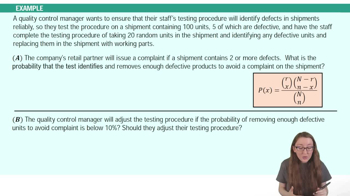
Introduction to the Hypergeometric Distribution
Within-Subjects Design
A within-subjects design means the same participants experience all treatment conditions. Here, each individual chewed food at 100%, 150%, and 200% of their baseline, which controls for individual differences and improves the reliability of the comparison.
Recommended video:
Guided course
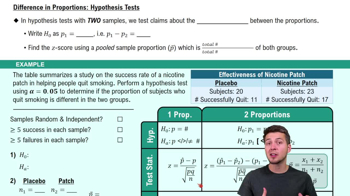
Difference in Proportions: Hypothesis Tests
Manipulation of Independent Variable
The independent variable is the factor that researchers change to observe its effect. In this study, the number of chews before swallowing is manipulated at different levels (100%, 150%, 200%) to assess its impact on food consumption.
Recommended video:
Guided course
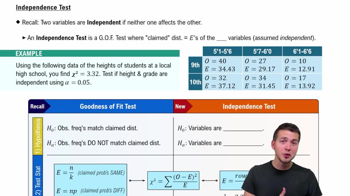
Independence Test
Watch next
Master Introduction to Statistics Channel with a bite sized video explanation from Patrick
Start learningRelated Videos
Related Practice
Textbook Question
5
views