
In a histogram, the heights of the bars correspond to which of the following values?
Table of contents
- 1. Intro to Stats and Collecting Data1h 14m
- 2. Describing Data with Tables and Graphs1h 55m
- 3. Describing Data Numerically2h 5m
- 4. Probability2h 16m
- 5. Binomial Distribution & Discrete Random Variables3h 6m
- 6. Normal Distribution and Continuous Random Variables2h 11m
- 7. Sampling Distributions & Confidence Intervals: Mean3h 23m
- Sampling Distribution of the Sample Mean and Central Limit Theorem19m
- Distribution of Sample Mean - Excel23m
- Introduction to Confidence Intervals15m
- Confidence Intervals for Population Mean1h 18m
- Determining the Minimum Sample Size Required12m
- Finding Probabilities and T Critical Values - Excel28m
- Confidence Intervals for Population Means - Excel25m
- 8. Sampling Distributions & Confidence Intervals: Proportion2h 10m
- 9. Hypothesis Testing for One Sample5h 6m
- Steps in Hypothesis Testing1h 6m
- Performing Hypothesis Tests: Means1h 4m
- Hypothesis Testing: Means - Excel42m
- Performing Hypothesis Tests: Proportions37m
- Hypothesis Testing: Proportions - Excel27m
- Performing Hypothesis Tests: Variance12m
- Critical Values and Rejection Regions28m
- Link Between Confidence Intervals and Hypothesis Testing12m
- Type I & Type II Errors15m
- 10. Hypothesis Testing for Two Samples4h 50m
- Two Proportions1h 13m
- Two Proportions Hypothesis Test - Excel28m
- Two Means - Unknown, Unequal Variance1h 3m
- Two Means - Unknown Variances Hypothesis Test - Excel12m
- Two Means - Unknown, Equal Variance15m
- Two Means - Unknown, Equal Variances Hypothesis Test - Excel9m
- Two Means - Known Variance12m
- Two Means - Sigma Known Hypothesis Test - Excel21m
- Two Means - Matched Pairs (Dependent Samples)42m
- Matched Pairs Hypothesis Test - Excel12m
- 11. Correlation1h 24m
- 12. Regression3h 33m
- Linear Regression & Least Squares Method26m
- Residuals12m
- Coefficient of Determination12m
- Regression Line Equation and Coefficient of Determination - Excel8m
- Finding Residuals and Creating Residual Plots - Excel11m
- Inferences for Slope31m
- Enabling Data Analysis Toolpak1m
- Regression Readout of the Data Analysis Toolpak - Excel21m
- Prediction Intervals13m
- Prediction Intervals - Excel19m
- Multiple Regression - Excel29m
- Quadratic Regression15m
- Quadratic Regression - Excel10m
- 13. Chi-Square Tests & Goodness of Fit2h 21m
- 14. ANOVA1h 57m
2. Describing Data with Tables and Graphs
Histograms
Problem 2.2.1
Textbook Question
IQ Scores IQ scores of adults are normally distributed. If a large sample of adults is randomly selected and the IQ scores are illustrated in a histogram, what is the shape of that histogram?
Verified step by step guidance1
Understand that IQ scores are normally distributed, which means they follow a bell-shaped curve.
Recall that a normal distribution is symmetric around its mean, with most of the data clustering around the center and tapering off towards the tails.
Visualize the histogram: it will have a peak at the mean IQ score, and the frequencies of scores will decrease symmetrically as you move away from the mean.
Recognize that the histogram will resemble a bell curve, which is characteristic of a normal distribution.
Conclude that the shape of the histogram for IQ scores will be approximately bell-shaped, reflecting the properties of a normal distribution.
Verified video answer for a similar problem:This video solution was recommended by our tutors as helpful for the problem above
Video duration:
2mPlay a video:
Was this helpful?
Key Concepts
Here are the essential concepts you must grasp in order to answer the question correctly.
Normal Distribution
A normal distribution is a continuous probability distribution characterized by a symmetric, bell-shaped curve. It is defined by its mean and standard deviation, with most data points clustering around the mean. In the context of IQ scores, which are normally distributed, this means that most individuals will have scores near the average, with fewer individuals having extremely high or low scores.
Recommended video:
Guided course
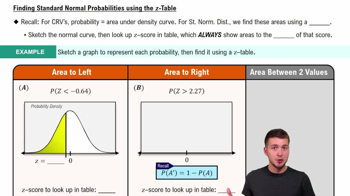
Finding Standard Normal Probabilities using z-Table
Histogram
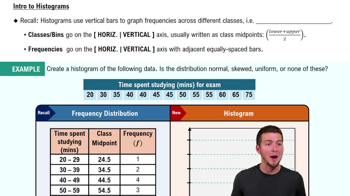
A histogram is a graphical representation of the distribution of numerical data, where data is grouped into bins or intervals. The height of each bar in a histogram represents the frequency of data points within each bin. For normally distributed data, such as IQ scores, the histogram will typically exhibit a bell-shaped curve, reflecting the underlying normal distribution.
Recommended video:
Guided course
Intro to Histograms
Central Limit Theorem
The Central Limit Theorem states that the distribution of the sample mean will approximate a normal distribution as the sample size becomes large, regardless of the shape of the population distribution. This concept is crucial in understanding why the histogram of a large sample of IQ scores, which are normally distributed, will also display a normal distribution shape, reinforcing the bell curve pattern.
Recommended video:
Guided course
Calculating the Mean
Related Videos
Related Practice
Multiple Choice
24
views
