
Ch. 5 - Normal Probability Distributions
Larson - Elementary Statistics: Picturing the World 8th Edition
Larson8th EditionElementary Statistics: Picturing the WorldISBN: 9780137493470Not the one you use?Change textbook
Chapter 5, Problem 5.1.60d

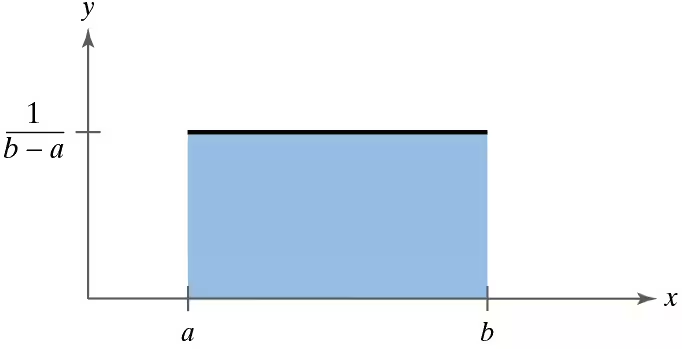
Uniform Distribution A uniform distribution is a continuous probability distribution for a random variable x between two values a and b (a<b), where (a ≤ x ≤ b) and all of the values of x are equally likely to occur. The graph of a uniform distribution is shown below.
Graph of a uniform distribution showing a rectangle between values a and b, with height 1/(b-a) and shaded area.
The probability density function of a uniform distribution is


Formula for the probability density function of a uniform distribution: y = 1 / (b - a).
on the interval from (x=a) to (x=b). For any value of x less than a or greater than b, y=0 . In Exercises 59 and 60, use this information.


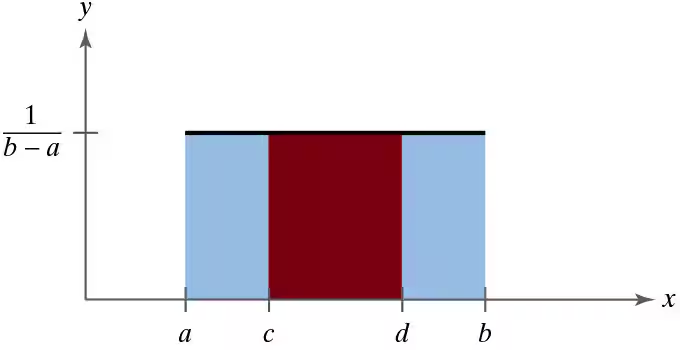
For two values c and d, where a ≤ c < d ≤ b, the probability that x lies between c and d is equal to the area under the curve between c and d, as shown below.


Graph of a uniform distribution showing a rectangular area between a and b, with a red region indicating probability between c and d.


So, the area of the red region equals the probability that x lies between c and d. For a uniform distribution from (a=1) to (b=25) , find the probability that


d. x lies between 8 and 14.

Verified step by step guidance
1
Step 1: Understand the uniform distribution. A uniform distribution is a continuous probability distribution where all values between two bounds (a and b) are equally likely. The probability density function is constant and given by y = 1 / (b - a).
Step 2: Identify the bounds of the distribution. In this problem, the uniform distribution is defined between a = 1 and b = 25. The height of the probability density function is y = 1 / (b - a), which simplifies to y = 1 / (25 - 1) = 1 / 24.
Step 3: Recognize that the probability of x lying between two values (c and d) is equal to the area under the curve between c and d. This area is a rectangle with height y = 1 / 24 and width equal to the difference between c and d.
Step 4: Determine the bounds for c and d. In this case, c = 8 and d = 14. The width of the rectangle is d - c = 14 - 8 = 6.
Step 5: Calculate the area of the rectangle, which represents the probability. The area is given by width × height = (d - c) × (1 / (b - a)). Substitute the values: Area = (14 - 8) × (1 / 24). This area represents the probability that x lies between 8 and 14.

Verified video answer for a similar problem:

This video solution was recommended by our tutors as helpful for the problem above.
Video duration:
1m
Was this helpful?

Key Concepts

Here are the essential concepts you must grasp in order to answer the question correctly.

Uniform Distribution

A uniform distribution is a type of probability distribution where all outcomes are equally likely within a specified range. For a continuous uniform distribution defined between two values, a and b, the probability density function is constant, meaning that the likelihood of the random variable falling anywhere between a and b is the same. This results in a rectangular shape when graphed, with the height determined by the formula 1/(b-a).
Recommended video:
Guided course
06:38
Intro to Frequency Distributions

Probability Density Function (PDF)

The probability density function (PDF) of a continuous random variable describes the likelihood of the variable taking on a particular value. For a uniform distribution, the PDF is defined as y = 1/(b-a) for values between a and b, and y = 0 outside this interval. The area under the PDF curve between any two points represents the probability that the random variable falls within that range.
Recommended video:
5:37
Introduction to Probability

Area Under the Curve

In the context of probability distributions, the area under the curve of the PDF represents the probability of the random variable falling within a specific interval. For a uniform distribution, this area can be calculated as the product of the width of the interval (d-c) and the height of the rectangle (1/(b-a)). This concept is crucial for determining probabilities in continuous distributions.
Recommended video:
Guided course
08:50
Z-Scores from Probabilities
Related Practice
Textbook Question

Finding Probabilities for Normal Distributions In Exercises 7–12, find the indicated probabilities. If convenient, use technology to find the probabilities.


Health Club Schedule The amounts of time per workout an athlete uses a stairclimber are normally distributed, with a mean of 20 minutes and a standard deviation of 5 minutes. Find the probability that a randomly selected athlete uses a stairclimber for (c) more than 30 minutes.

109
views
Textbook Question

Employee Wellness A survey of employed U.S. adults found that only 35% believe their employer cares about their well-being. You randomly select a sample of U.S. employees. Find the probability that fewer than 100 believe their employer cares about their well-being. (Source: Gallup)


c. You select 400 U.S. employees.

106
views
Textbook Question

History Grades In a history class, the grades for various assessments are all positive numbers and have different distributions. Determine whether the grades for each assessment could be normally distributed. Explain your reasoning.


e. an extra credit assignment with a mean of 2.25 and a standard deviation of 2.49

76
views
Textbook Question

Finding Probabilities for Normal Distributions In Exercises 7–12, find the indicated probabilities. If convenient, use technology to find the probabilities.


MCAT Scores In a recent year, the MCAT total scores were normally distributed, with a mean of 500.9 and a standard deviation of 10.6. Find the probability that a randomly selected medical student who took the MCAT has a total score that is (c) more than 515. Identify any unusual events in parts (a)–(c). Explain your reasoning. (Source: Association of American Medical Colleges)

78
views