[NOW WORK] [DATA] The Other Old Faithful Perhaps you are familiar with the famous Old Faithful geyser in Yellowstone National Park. Another Old Faithful geyser is located in Calistoga in California’s Napa Valley. The following data represent the time (in minutes) between eruptions and the length of eruption for 9 randomly selected eruptions. The coefficient of determination is 83.0%. Provide an interpretation of this value.
Table of contents
- 1. Intro to Stats and Collecting Data1h 14m
- 2. Describing Data with Tables and Graphs1h 55m
- 3. Describing Data Numerically2h 5m
- 4. Probability2h 16m
- 5. Binomial Distribution & Discrete Random Variables3h 6m
- 6. Normal Distribution and Continuous Random Variables2h 11m
- 7. Sampling Distributions & Confidence Intervals: Mean3h 23m
- Sampling Distribution of the Sample Mean and Central Limit Theorem19m
- Distribution of Sample Mean - Excel23m
- Introduction to Confidence Intervals15m
- Confidence Intervals for Population Mean1h 18m
- Determining the Minimum Sample Size Required12m
- Finding Probabilities and T Critical Values - Excel28m
- Confidence Intervals for Population Means - Excel25m
- 8. Sampling Distributions & Confidence Intervals: Proportion1h 25m
- 9. Hypothesis Testing for One Sample3h 29m
- 10. Hypothesis Testing for Two Samples4h 50m
- Two Proportions1h 13m
- Two Proportions Hypothesis Test - Excel28m
- Two Means - Unknown, Unequal Variance1h 3m
- Two Means - Unknown Variances Hypothesis Test - Excel12m
- Two Means - Unknown, Equal Variance15m
- Two Means - Unknown, Equal Variances Hypothesis Test - Excel9m
- Two Means - Known Variance12m
- Two Means - Sigma Known Hypothesis Test - Excel21m
- Two Means - Matched Pairs (Dependent Samples)42m
- Matched Pairs Hypothesis Test - Excel12m
- 11. Correlation1h 24m
- 12. Regression1h 50m
- 13. Chi-Square Tests & Goodness of Fit2h 21m
- 14. ANOVA1h 57m
12. Regression
Coefficient of Determination
Problem 4.3.7a
Textbook Question
Problems 7–12 use the results from Problems 27–32 in Section 4.1 and Problems 17–22 in Section 4.2.
a. Determine the coefficient of determination, R^2.
Verified step by step guidance1
Identify the context of the problem by reviewing the results from the referenced problems (Problems 27–32 in Section 4.1 and Problems 17–22 in Section 4.2). These likely contain values such as the correlation coefficient or sums of squares needed for the calculation.
Recall that the coefficient of determination, denoted as \(R^2\), measures the proportion of the variance in the dependent variable that is predictable from the independent variable(s). It is calculated as the square of the correlation coefficient \(r\) when dealing with simple linear regression.
If you have the correlation coefficient \(r\), compute \(R^2\) using the formula:
\[R^2 = r^2\]
Alternatively, if you have the sums of squares from the regression analysis, use the formula:
\[R^2 = \frac{SS_{regression}}{SS_{total}}\]
where \(SS_{regression}\) is the sum of squares due to regression and \(SS_{total}\) is the total sum of squares.
Once you have the necessary values from the previous problems, substitute them into the appropriate formula and calculate \(R^2\) to determine the coefficient of determination.
Verified video answer for a similar problem:This video solution was recommended by our tutors as helpful for the problem above
Video duration:
1mPlay a video:
Was this helpful?
Key Concepts
Here are the essential concepts you must grasp in order to answer the question correctly.
Coefficient of Determination (R²)
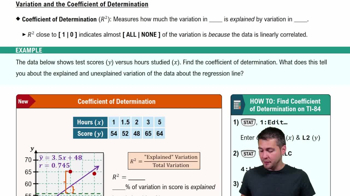
R² measures the proportion of variance in the dependent variable explained by the independent variable(s) in a regression model. It ranges from 0 to 1, where higher values indicate a better fit. R² helps assess how well the model explains the data.
Recommended video:
Guided course
Coefficient of Determination
Regression Analysis
Regression analysis estimates the relationship between variables, typically predicting a dependent variable from one or more independent variables. Understanding regression output, such as sums of squares and regression coefficients, is essential to calculate and interpret R².
Recommended video:
Guided course
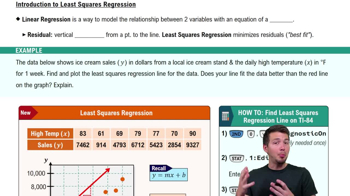
Intro to Least Squares Regression
Sum of Squares (Total, Regression, and Error)
Sum of squares quantify variability in data: Total SS measures overall variance, Regression SS measures explained variance by the model, and Error SS measures unexplained variance. R² is calculated as Regression SS divided by Total SS, showing explained variance proportion.
Recommended video:
Guided course
Intro to Least Squares Regression
Watch next
Master Coefficient of Determination with a bite sized video explanation from Patrick
Start learningRelated Videos
Related Practice
Textbook Question
9
views