Problems 7–12 use the results from Problems 27–32 in Section 4.1 and Problems 17–22 in Section 4.2. b.Interpret the coefficient of determination and comment on the adequacy of the linear model..
Verified step by step guidance
1
Identify the coefficient of determination, denoted as \(R^{2}\), from the results of the linear regression model. This value is usually provided in the output of Problems 27–32 in Section 4.1 or Problems 17–22 in Section 4.2.
Recall that the coefficient of determination \(R^{2}\) represents the proportion of the variance in the dependent variable that is predictable from the independent variable(s). It is calculated as \(R^{2} = 1 - \frac{SS_{\text{res}}}{SS_{\text{tot}}}\), where \(SS_{\text{res}}\) is the residual sum of squares and \(SS_{\text{tot}}\) is the total sum of squares.
Interpret the value of \(R^{2}\) in context: a value close to 1 indicates that a large proportion of the variability in the response variable is explained by the model, while a value close to 0 indicates poor explanatory power.
Evaluate the adequacy of the linear model by considering the magnitude of \(R^{2}\) along with other diagnostic measures such as residual plots or significance tests (if available). A high \(R^{2}\) suggests the model fits well, but also check for any patterns in residuals that might indicate model inadequacy.
Summarize your interpretation by stating how well the linear model explains the data variability and whether it is appropriate to use this model for prediction or inference based on the coefficient of determination and any other relevant information.
Verified video answer for a similar problem:
This video solution was recommended by our tutors as helpful for the problem above
Video duration:
2m
Play a video:
0 Comments
Key Concepts
Here are the essential concepts you must grasp in order to answer the question correctly.
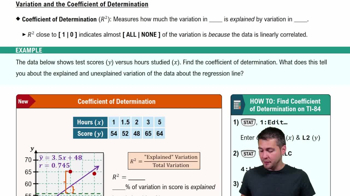
Coefficient of Determination (R²)
The coefficient of determination, denoted as R², measures the proportion of the variance in the dependent variable that is predictable from the independent variable(s). It ranges from 0 to 1, where a higher value indicates a better fit of the linear model to the data. R² helps assess how well the model explains the observed outcomes.
Interpreting R² involves understanding what the value implies about the relationship between variables. For example, an R² of 0.75 means 75% of the variability in the response variable is explained by the model, suggesting a strong linear relationship. However, it does not imply causation or guarantee model adequacy alone.
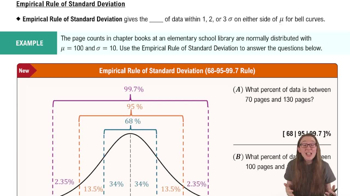
Empirical Rule of Standard Deviation and Range Rule of Thumb
Adequacy of the Linear Model
Assessing model adequacy involves evaluating whether the linear model appropriately fits the data, considering R², residual plots, and assumptions like linearity and homoscedasticity. A high R² alone is insufficient; checking residual patterns and other diagnostics ensures the model reliably represents the data.

 2:59 minutes
 Verified step by step guidance
 06:14
06:14