[DATA] Putting It Together: Cigarette Smuggling Go to www.pearsonhighered.com/sullivanstats to obtain the data file 4_3_33. The data represent the 2015 tax rate per pack of cigarettes and the percent of cigarettes smuggled as a percentage of total consumption. A negative value of consumption represents a net outflow of cigarettes while a positive value represents an inflow of cigarettes. For example, in Alabama, 7.5% of all cigarettes purchased leave the state. In Arizona, 44.8% of all cigarettes consumed are smuggled into the state. Alaska, Hawaii, North Carolina, and the District of Columbia are not included in the analysis. Describe the data and write an article that discusses the impact that cigarette taxes may have on smuggling.
Verified step by step guidance
1
Step 1: Begin by summarizing the data set. Identify the variables involved: the 2015 tax rate per pack of cigarettes (independent variable) and the percent of cigarettes smuggled as a percentage of total consumption (dependent variable). Note the meaning of positive and negative values in smuggling percentages (inflow vs. outflow).
Step 2: Use descriptive statistics to describe each variable separately. Calculate measures such as the mean, median, range, and standard deviation for both the tax rates and the smuggling percentages. This will give a sense of the central tendency and variability in the data.
Step 3: Create a scatterplot with the tax rate on the x-axis and the smuggling percentage on the y-axis. This visual will help identify any apparent relationship or pattern between cigarette taxes and smuggling rates.
Step 4: Calculate the correlation coefficient between the tax rate and the smuggling percentage to quantify the strength and direction of their linear relationship. The formula for Pearson's correlation coefficient is: \[ r = \frac{\sum (x_i - \bar{x})(y_i - \bar{y})}{\sqrt{\sum (x_i - \bar{x})^2 \sum (y_i - \bar{y})^2}} \] where \(x_i\) and \(y_i\) are individual data points, and \(\bar{x}\) and \(\bar{y}\) are the means of the respective variables.
Step 5: Based on the correlation and scatterplot, discuss the potential impact of cigarette taxes on smuggling. Consider whether higher taxes are associated with higher smuggling percentages, and explain possible reasons for this relationship, such as economic incentives for smuggling when taxes are high.
Verified video answer for a similar problem:
This video solution was recommended by our tutors as helpful for the problem above
Video duration:
2m
Play a video:
0 Comments
Key Concepts
Here are the essential concepts you must grasp in order to answer the question correctly.
Correlation and Causation
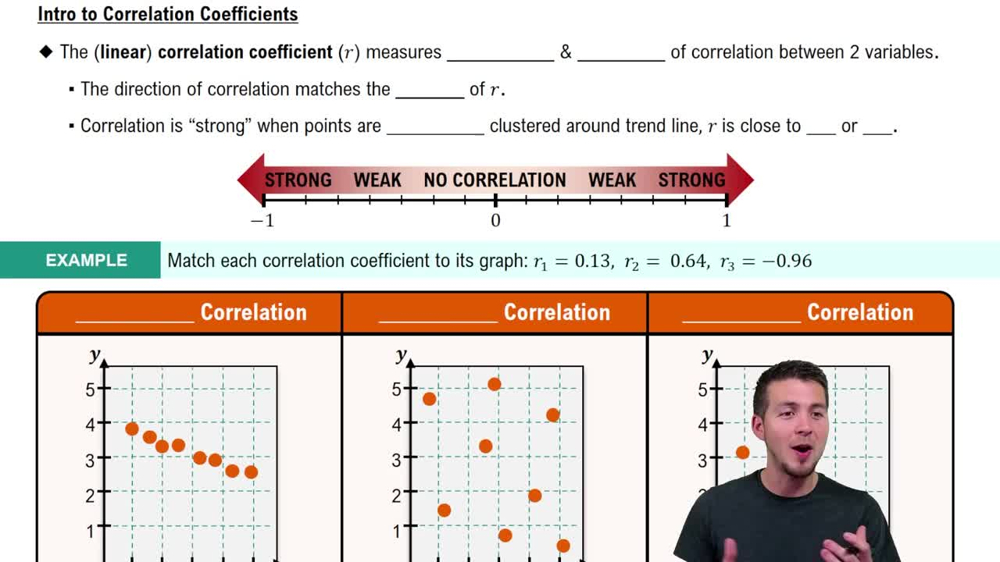
Correlation measures the strength and direction of a relationship between two variables, such as tax rates and smuggling percentages. However, correlation does not imply causation; a high correlation does not prove that higher taxes cause more smuggling. Understanding this distinction is crucial when interpreting data and drawing conclusions.
Descriptive statistics summarize and describe the main features of a dataset, including measures like mean, median, range, and standard deviation. These statistics help to understand the distribution and variability of tax rates and smuggling percentages across states, providing a foundation for further analysis.
Interpreting data involves analyzing numerical results within the real-world context, considering factors like state policies, geographic location, and economic incentives. For cigarette smuggling, understanding how tax differences influence consumer behavior and smuggling patterns is essential to write an informed article.