The word "and" in probability implies that we use the ______ Rule.
Table of contents
- 1. Intro to Stats and Collecting Data1h 14m
- 2. Describing Data with Tables and Graphs1h 55m
- 3. Describing Data Numerically2h 5m
- 4. Probability2h 16m
- 5. Binomial Distribution & Discrete Random Variables3h 6m
- 6. Normal Distribution and Continuous Random Variables2h 11m
- 7. Sampling Distributions & Confidence Intervals: Mean3h 23m
- Sampling Distribution of the Sample Mean and Central Limit Theorem19m
- Distribution of Sample Mean - Excel23m
- Introduction to Confidence Intervals15m
- Confidence Intervals for Population Mean1h 18m
- Determining the Minimum Sample Size Required12m
- Finding Probabilities and T Critical Values - Excel28m
- Confidence Intervals for Population Means - Excel25m
- 8. Sampling Distributions & Confidence Intervals: Proportion1h 25m
- 9. Hypothesis Testing for One Sample3h 29m
- 10. Hypothesis Testing for Two Samples4h 50m
- Two Proportions1h 13m
- Two Proportions Hypothesis Test - Excel28m
- Two Means - Unknown, Unequal Variance1h 3m
- Two Means - Unknown Variances Hypothesis Test - Excel12m
- Two Means - Unknown, Equal Variance15m
- Two Means - Unknown, Equal Variances Hypothesis Test - Excel9m
- Two Means - Known Variance12m
- Two Means - Sigma Known Hypothesis Test - Excel21m
- Two Means - Matched Pairs (Dependent Samples)42m
- Matched Pairs Hypothesis Test - Excel12m
- 11. Correlation1h 24m
- 12. Regression1h 50m
- 13. Chi-Square Tests & Goodness of Fit2h 21m
- 14. ANOVA1h 57m
4. Probability
Multiplication Rule: Independent Events
Problem 5.3.18b
Textbook Question
Earn More Than Your Parents?
In 1970, 92% of American 30-year-olds earned more than their parents did at age 30 (adjusted for inflation). In 2014, only 51% of American 30-year-olds earned more than their parents did at age 30. Source: Wall Street Journal, December 8, 2016.
b. What is the probability that two randomly selected 30-year-olds in 1970 earned more than their parents at age 30?
Verified step by step guidance1
Identify the probability that a single 30-year-old in 1970 earned more than their parents at age 30. According to the problem, this probability is 0.92 (or 92%).
Since the problem asks for the probability that two randomly selected 30-year-olds both earned more than their parents, recognize that these are independent events assuming one person's earnings do not affect the other's.
Use the multiplication rule for independent events, which states that the probability of both events occurring is the product of their individual probabilities.
Set up the equation for the combined probability: \(P(\text{both earn more}) = P(\text{first earns more}) \times P(\text{second earns more})\).
Substitute the known probability values into the equation: \(P(\text{both earn more}) = 0.92 \times 0.92\).
Verified video answer for a similar problem:This video solution was recommended by our tutors as helpful for the problem above
Video duration:
1mPlay a video:
Was this helpful?
Key Concepts
Here are the essential concepts you must grasp in order to answer the question correctly.
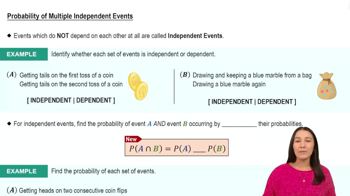
Probability of Independent Events
When two events are independent, the probability that both occur is the product of their individual probabilities. In this question, assuming each 30-year-old's earning status relative to their parents is independent, the combined probability is found by multiplying the probabilities for each individual.
Recommended video:
Probability of Multiple Independent Events
Interpreting Percentage as Probability
Percentages can be converted into probabilities by dividing by 100. Here, 92% means a probability of 0.92 that a randomly selected 30-year-old in 1970 earned more than their parents, which is essential for calculating combined probabilities.
Recommended video:
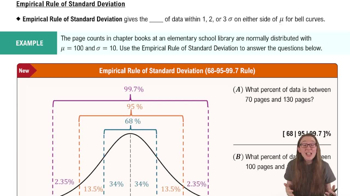
Empirical Rule of Standard Deviation and Range Rule of Thumb
Contextual Understanding of Data
Understanding the context—such as the year, age group, and inflation adjustment—is crucial to correctly interpret the data and apply it to probability calculations. This ensures the probability reflects the specific scenario described in the question.
Recommended video:
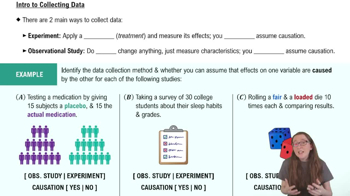
Introduction to Collecting Data
Watch next
Master Probability of Multiple Independent Events with a bite sized video explanation from Patrick
Start learningRelated Videos
Related Practice
Textbook Question
3
views