Use the Venn diagram to identify the population and the sample.
Table of contents
- 1. Intro to Stats and Collecting Data1h 14m
- 2. Describing Data with Tables and Graphs1h 55m
- 3. Describing Data Numerically2h 5m
- 4. Probability2h 16m
- 5. Binomial Distribution & Discrete Random Variables3h 6m
- 6. Normal Distribution and Continuous Random Variables2h 11m
- 7. Sampling Distributions & Confidence Intervals: Mean3h 23m
- Sampling Distribution of the Sample Mean and Central Limit Theorem19m
- Distribution of Sample Mean - Excel23m
- Introduction to Confidence Intervals15m
- Confidence Intervals for Population Mean1h 18m
- Determining the Minimum Sample Size Required12m
- Finding Probabilities and T Critical Values - Excel28m
- Confidence Intervals for Population Means - Excel25m
- 8. Sampling Distributions & Confidence Intervals: Proportion1h 25m
- 9. Hypothesis Testing for One Sample3h 29m
- 10. Hypothesis Testing for Two Samples4h 50m
- Two Proportions1h 13m
- Two Proportions Hypothesis Test - Excel28m
- Two Means - Unknown, Unequal Variance1h 3m
- Two Means - Unknown Variances Hypothesis Test - Excel12m
- Two Means - Unknown, Equal Variance15m
- Two Means - Unknown, Equal Variances Hypothesis Test - Excel9m
- Two Means - Known Variance12m
- Two Means - Sigma Known Hypothesis Test - Excel21m
- Two Means - Matched Pairs (Dependent Samples)42m
- Matched Pairs Hypothesis Test - Excel12m
- 11. Correlation1h 24m
- 12. Regression1h 50m
- 13. Chi-Square Tests & Goodness of Fit2h 21m
- 14. ANOVA1h 57m
1. Intro to Stats and Collecting Data
Intro to Collecting Data
Problem 1.3.11
Textbook Question
Determine whether the study is an observational study or an experiment. Explain.
A research study compared the memory retention of subjects when a learning activity was followed by a brief period of wakeful rest and when a learning activity was followed by a brief period of distraction. (Source: Springer Nature)
Verified step by step guidance1
Identify the key characteristics of an observational study: In an observational study, researchers observe and measure variables without manipulating them. The goal is to study relationships or patterns as they naturally occur.
Identify the key characteristics of an experiment: In an experiment, researchers actively manipulate one or more variables (independent variables) to observe the effect on other variables (dependent variables). Experiments often involve random assignment to groups and controlled conditions.
Analyze the details of the study: In this case, the researchers compared memory retention under two different conditions: (1) after a learning activity followed by wakeful rest, and (2) after a learning activity followed by distraction. This suggests that the researchers controlled the conditions and assigned subjects to specific groups.
Determine whether manipulation occurred: Since the researchers actively controlled the conditions (wakeful rest vs. distraction) and likely assigned participants to these conditions, this indicates that the study involved manipulation of variables.
Conclude the type of study: Based on the presence of manipulation and controlled conditions, this study is classified as an experiment, not an observational study.
Verified video answer for a similar problem:This video solution was recommended by our tutors as helpful for the problem above
Video duration:
2mPlay a video:
Was this helpful?
Key Concepts
Here are the essential concepts you must grasp in order to answer the question correctly.
Observational Study
An observational study is a type of research where the investigator observes subjects in their natural environment without manipulating any variables. The goal is to gather data on behaviors or outcomes as they occur naturally. This approach is useful for identifying correlations but does not establish causation, as the researcher does not intervene in the study.
Recommended video:
Guided course
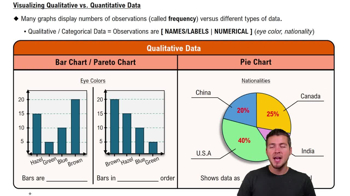
Visualizing Qualitative vs. Quantitative Data
Experiment
An experiment is a research method where the investigator manipulates one or more independent variables to observe the effect on a dependent variable. This controlled approach allows researchers to establish cause-and-effect relationships. In experiments, subjects are often randomly assigned to different conditions to minimize bias and ensure that results are due to the manipulation rather than other factors.
Recommended video:
Guided course
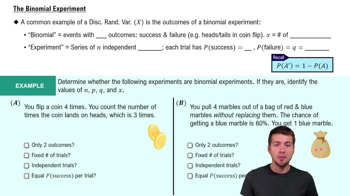
The Binomial Experiment
Control Group
A control group is a baseline group in an experiment that does not receive the treatment or intervention being tested. This group is essential for comparison, as it helps to isolate the effects of the independent variable. By comparing outcomes between the experimental group and the control group, researchers can better understand the impact of the treatment or intervention.
Recommended video:
Guided course
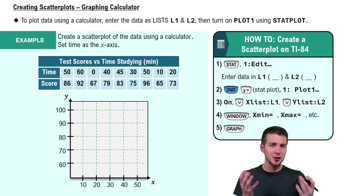
Creating Scatterplots - Graphing Calculator
Watch next
Master Introduction to Collecting Data with a bite sized video explanation from Patrick
Start learningRelated Videos
Related Practice
Textbook Question
143
views