In sampling from finite populations without replacement, the assumption of independence required for a binomial experiment is violated. Under what circumstances can we sample without replacement and still use the binomial probability formula to approximate probabilities?
Table of contents
- 1. Intro to Stats and Collecting Data1h 14m
- 2. Describing Data with Tables and Graphs1h 55m
- 3. Describing Data Numerically2h 5m
- 4. Probability2h 16m
- 5. Binomial Distribution & Discrete Random Variables3h 6m
- 6. Normal Distribution and Continuous Random Variables2h 11m
- 7. Sampling Distributions & Confidence Intervals: Mean3h 23m
- Sampling Distribution of the Sample Mean and Central Limit Theorem19m
- Distribution of Sample Mean - Excel23m
- Introduction to Confidence Intervals15m
- Confidence Intervals for Population Mean1h 18m
- Determining the Minimum Sample Size Required12m
- Finding Probabilities and T Critical Values - Excel28m
- Confidence Intervals for Population Means - Excel25m
- 8. Sampling Distributions & Confidence Intervals: Proportion1h 25m
- 9. Hypothesis Testing for One Sample3h 29m
- 10. Hypothesis Testing for Two Samples4h 50m
- Two Proportions1h 13m
- Two Proportions Hypothesis Test - Excel28m
- Two Means - Unknown, Unequal Variance1h 3m
- Two Means - Unknown Variances Hypothesis Test - Excel12m
- Two Means - Unknown, Equal Variance15m
- Two Means - Unknown, Equal Variances Hypothesis Test - Excel9m
- Two Means - Known Variance12m
- Two Means - Sigma Known Hypothesis Test - Excel21m
- Two Means - Matched Pairs (Dependent Samples)42m
- Matched Pairs Hypothesis Test - Excel12m
- 11. Correlation1h 24m
- 12. Regression1h 50m
- 13. Chi-Square Tests & Goodness of Fit2h 21m
- 14. ANOVA1h 57m
5. Binomial Distribution & Discrete Random Variables
Binomial Distribution
Problem 10.2B.31f
Textbook Question
Simulation: Predicting the Future Parapsychology (psi) is a field of study that deals with clairvoyance or precognition. Psi made its way back into the news when a professional, refereed journal published an article by Cornell psychologist Daryl Bem, in which he claimed to demonstrate that psi is a real phenomenon. In the article Bem stated that certain individuals behave today as if they already know what is going to happen in the future. That is, individuals adjust current behavior in anticipation of events that are going to happen in the future. Here, we will present a simplified version of Bem’s research.
f. Look at the graph of the outcomes of the simulation from part (c). Explain why the normal model might be used to estimate the probability of obtaining at least 24 correct guesses in 40 trials assuming the probability of success is 0.5. Use the model to estimate the P-value.
Verified step by step guidance1
Step 1: Recognize that the problem involves a binomial distribution because each trial has two possible outcomes (correct guess or incorrect guess), with a fixed number of trials (n = 40) and a constant probability of success (p = 0.5).
Step 2: Understand that the normal model can be used to approximate the binomial distribution when the sample size is large enough. A common rule of thumb is that both np and n(1-p) should be at least 10. Calculate np = 40 \times 0.5 and n(1-p) = 40 \times 0.5 to verify this condition.
Step 3: Since the condition is met, approximate the binomial distribution with a normal distribution having mean \(\mu = np\) and standard deviation \(\sigma = \sqrt{np(1-p)}\).
Step 4: Apply the continuity correction by adjusting the value of interest (24 correct guesses) by 0.5 to better approximate the discrete binomial with the continuous normal distribution. For "at least 24", use 23.5 as the cutoff point.
Step 5: Calculate the z-score using the formula \(z = \frac{23.5 - \mu}{\sigma}\), then use the standard normal distribution table or a calculator to find the probability corresponding to this z-score. This probability is the estimated P-value for obtaining at least 24 correct guesses.
Verified video answer for a similar problem:This video solution was recommended by our tutors as helpful for the problem above
Video duration:
3mPlay a video:
Was this helpful?
Key Concepts
Here are the essential concepts you must grasp in order to answer the question correctly.
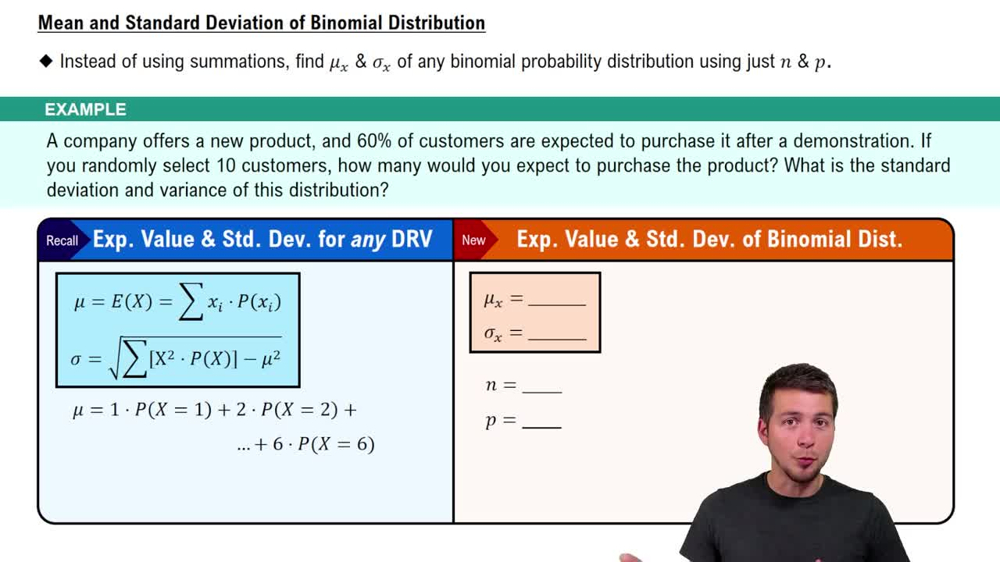
Binomial Distribution
The binomial distribution models the number of successes in a fixed number of independent trials, each with the same probability of success. In this question, guessing correctly in 40 trials with a 0.5 success probability fits a binomial setting. Understanding this distribution helps calculate exact probabilities for outcomes like getting at least 24 correct guesses.
Recommended video:
Guided course
Mean & Standard Deviation of Binomial Distribution
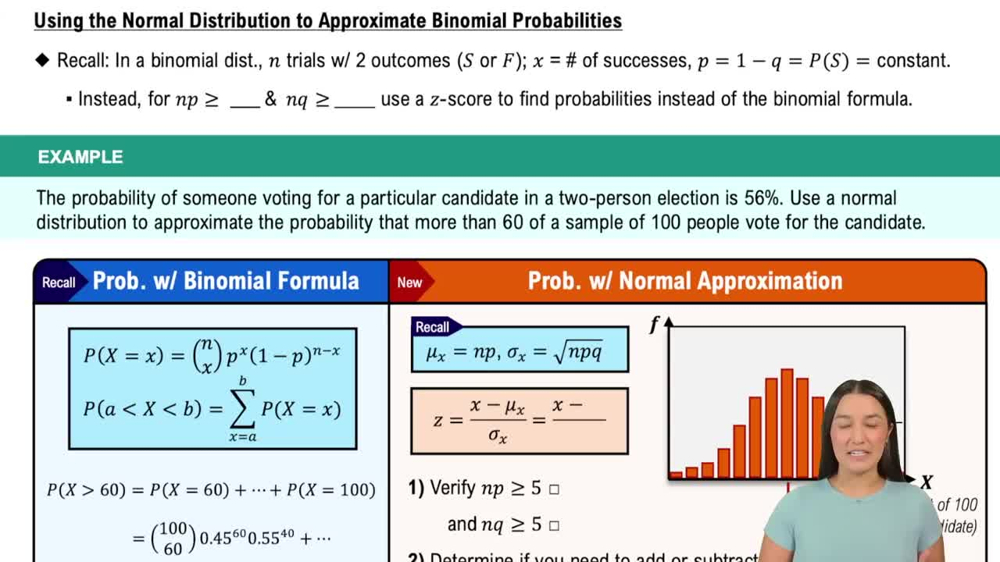
Normal Approximation to the Binomial
When the number of trials is large, the binomial distribution can be approximated by a normal distribution with mean np and variance np(1-p). This simplifies calculations, especially for cumulative probabilities. Here, with 40 trials and p=0.5, the normal model is appropriate to estimate the probability of 24 or more successes.
Recommended video:
Using the Normal Distribution to Approximate Binomial Probabilities
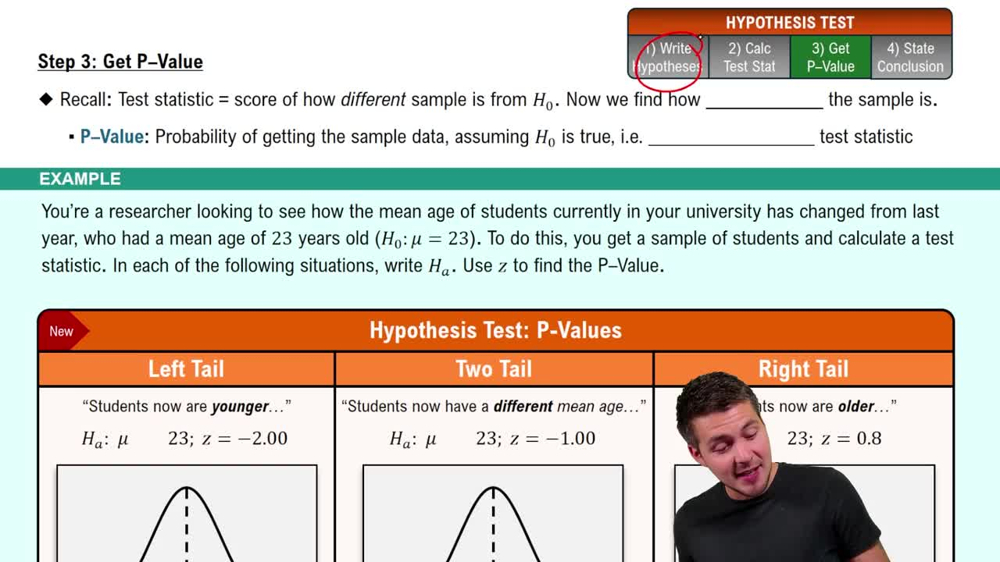
P-value and Hypothesis Testing
A P-value measures the probability of observing data as extreme as, or more extreme than, the actual results under the null hypothesis. In this context, it quantifies how likely it is to get at least 24 correct guesses by chance if the true success rate is 0.5. A small P-value suggests evidence against the null hypothesis.
Recommended video:
Guided course
Step 3: Get P-Value
Watch next
Master The Binomial Experiment with a bite sized video explanation from Patrick
Start learningRelated Videos
Related Practice
Textbook Question
4
views