For each repetition of a binomial experiment, there are two mutually exclusive outcomes: ________ or ________.
Table of contents
- 1. Intro to Stats and Collecting Data1h 14m
- 2. Describing Data with Tables and Graphs1h 55m
- 3. Describing Data Numerically2h 5m
- 4. Probability2h 16m
- 5. Binomial Distribution & Discrete Random Variables3h 6m
- 6. Normal Distribution and Continuous Random Variables2h 11m
- 7. Sampling Distributions & Confidence Intervals: Mean3h 23m
- Sampling Distribution of the Sample Mean and Central Limit Theorem19m
- Distribution of Sample Mean - Excel23m
- Introduction to Confidence Intervals15m
- Confidence Intervals for Population Mean1h 18m
- Determining the Minimum Sample Size Required12m
- Finding Probabilities and T Critical Values - Excel28m
- Confidence Intervals for Population Means - Excel25m
- 8. Sampling Distributions & Confidence Intervals: Proportion1h 25m
- 9. Hypothesis Testing for One Sample3h 29m
- 10. Hypothesis Testing for Two Samples4h 50m
- Two Proportions1h 13m
- Two Proportions Hypothesis Test - Excel28m
- Two Means - Unknown, Unequal Variance1h 3m
- Two Means - Unknown Variances Hypothesis Test - Excel12m
- Two Means - Unknown, Equal Variance15m
- Two Means - Unknown, Equal Variances Hypothesis Test - Excel9m
- Two Means - Known Variance12m
- Two Means - Sigma Known Hypothesis Test - Excel21m
- Two Means - Matched Pairs (Dependent Samples)42m
- Matched Pairs Hypothesis Test - Excel12m
- 11. Correlation1h 24m
- 12. Regression1h 50m
- 13. Chi-Square Tests & Goodness of Fit2h 21m
- 14. ANOVA1h 57m
5. Binomial Distribution & Discrete Random Variables
Binomial Distribution
Problem 6.2.60
Textbook Question
When can the Empirical Rule be used to identify unusual results in a binomial experiment? Why can the Empirical Rule be used to identify results in a binomial experiment?
Verified step by step guidance1
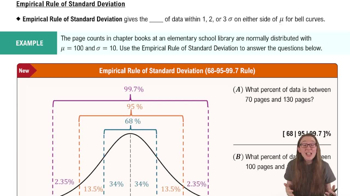
Step 1: Understand the Empirical Rule, which states that for a normal distribution, approximately 68% of data falls within 1 standard deviation of the mean, 95% within 2 standard deviations, and 99.7% within 3 standard deviations.
Step 2: Recognize that the Empirical Rule applies directly to normal distributions, so to use it for a binomial experiment, the binomial distribution must be approximately normal.
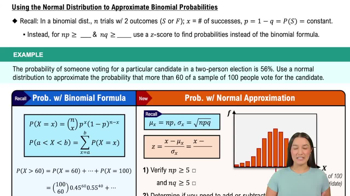
Step 3: Identify the conditions under which a binomial distribution can be approximated by a normal distribution: when both \(n p \geq 10\) and \(n (1 - p) \geq 10\), where \(n\) is the number of trials and \(p\) is the probability of success.
Step 4: Calculate the mean \(\mu = n p\) and the standard deviation \(\sigma = \sqrt{n p (1 - p)}\) of the binomial distribution to apply the Empirical Rule.
Step 5: Use the Empirical Rule to determine if a result is unusual by checking if it lies more than 2 or 3 standard deviations away from the mean, indicating it is unlikely under the binomial model.
Verified video answer for a similar problem:This video solution was recommended by our tutors as helpful for the problem above
Video duration:
1mPlay a video:
Was this helpful?
Key Concepts
Here are the essential concepts you must grasp in order to answer the question correctly.
Empirical Rule
The Empirical Rule states that for a normal distribution, about 68% of data falls within one standard deviation, 95% within two, and 99.7% within three. It helps identify unusual results by showing how far a value deviates from the mean in terms of standard deviations.
Recommended video:
Empirical Rule of Standard Deviation and Range Rule of Thumb
Binomial Distribution Approximation to Normal
A binomial distribution can be approximated by a normal distribution when the number of trials is large and both np and n(1-p) are greater than 5. This allows the use of normal-based methods, like the Empirical Rule, to analyze binomial outcomes.
Recommended video:
Using the Normal Distribution to Approximate Binomial Probabilities
Identifying Unusual Results
Unusual results in a binomial experiment are outcomes that lie far from the expected value, typically beyond two or three standard deviations. Using the Empirical Rule on the normal approximation helps determine if a result is statistically rare or unusual.
Recommended video:
Guided course
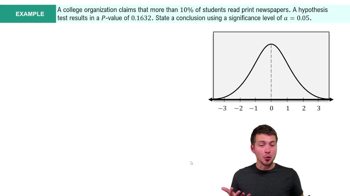
Step 4: State Conclusion Example 4
Watch next
Master The Binomial Experiment with a bite sized video explanation from Patrick
Start learningRelated Videos
Related Practice
Textbook Question
12
views