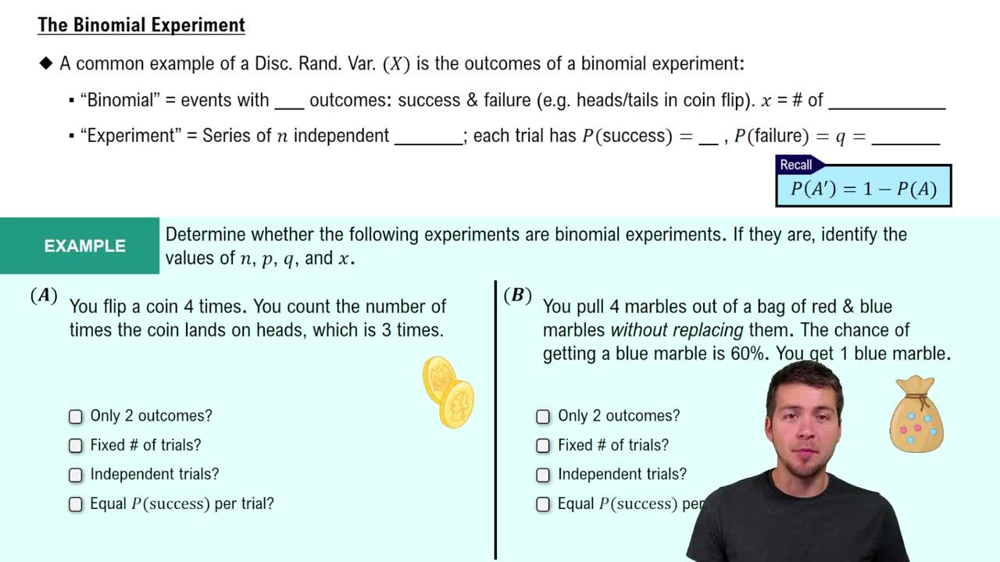
For each repetition of a binomial experiment, there are two mutually exclusive outcomes: ________ or ________.
Verified step by step guidance
1
Understand that a binomial experiment consists of repeated trials where each trial has exactly two possible outcomes.
Recognize that these two outcomes are mutually exclusive, meaning they cannot happen at the same time in a single trial.
Identify the common terminology used for these outcomes: one is called a 'success' and the other is called a 'failure'.
Note that the terms 'success' and 'failure' are labels and do not necessarily imply positive or negative results; they simply distinguish the two possible outcomes.
Therefore, for each repetition of a binomial experiment, the two mutually exclusive outcomes are 'success' or 'failure'.
Verified video answer for a similar problem:
This video solution was recommended by our tutors as helpful for the problem above
Video duration:
1m
Play a video:
0 Comments
Key Concepts
Here are the essential concepts you must grasp in order to answer the question correctly.
Binomial Experiment
A binomial experiment consists of a fixed number of independent trials, each with exactly two possible outcomes. These outcomes are often labeled as 'success' or 'failure', and the probability of success remains constant across trials.
Mutually exclusive outcomes are events that cannot occur simultaneously in a single trial. In a binomial experiment, the two outcomes (success or failure) are mutually exclusive, meaning if one occurs, the other cannot.
In binomial experiments, 'success' and 'failure' are labels for the two possible outcomes of each trial. These terms are arbitrary and depend on the context, but they help in defining probabilities and calculating binomial distributions.

 1:23 minutes
 Verified step by step guidance
 06:00
06:00