
What is the probability that a card player draws two aces from a standard deck of 52 cards if they keep the first card after drawing it?
Table of contents
- 1. Intro to Stats and Collecting Data1h 14m
- 2. Describing Data with Tables and Graphs1h 55m
- 3. Describing Data Numerically2h 5m
- 4. Probability2h 16m
- 5. Binomial Distribution & Discrete Random Variables3h 6m
- 6. Normal Distribution and Continuous Random Variables2h 11m
- 7. Sampling Distributions & Confidence Intervals: Mean3h 23m
- Sampling Distribution of the Sample Mean and Central Limit Theorem19m
- Distribution of Sample Mean - Excel23m
- Introduction to Confidence Intervals15m
- Confidence Intervals for Population Mean1h 18m
- Determining the Minimum Sample Size Required12m
- Finding Probabilities and T Critical Values - Excel28m
- Confidence Intervals for Population Means - Excel25m
- 8. Sampling Distributions & Confidence Intervals: Proportion1h 25m
- 9. Hypothesis Testing for One Sample3h 29m
- 10. Hypothesis Testing for Two Samples4h 50m
- Two Proportions1h 13m
- Two Proportions Hypothesis Test - Excel28m
- Two Means - Unknown, Unequal Variance1h 3m
- Two Means - Unknown Variances Hypothesis Test - Excel12m
- Two Means - Unknown, Equal Variance15m
- Two Means - Unknown, Equal Variances Hypothesis Test - Excel9m
- Two Means - Known Variance12m
- Two Means - Sigma Known Hypothesis Test - Excel21m
- Two Means - Matched Pairs (Dependent Samples)42m
- Matched Pairs Hypothesis Test - Excel12m
- 11. Correlation1h 24m
- 12. Regression1h 50m
- 13. Chi-Square Tests & Goodness of Fit2h 21m
- 14. ANOVA1h 57m
4. Probability
Multiplication Rule: Dependent Events
Problem 3.2.23c
Textbook Question
"Using the Multiplication Rule In Exercises 19-32, use the Multiplication Rule.
23. Celebrities as Role Models In a sample of 1103 probable voters, three out of four say they would like entertainers to address social and political issues. Two probable voters are selected at random. (Source: The Hollywood Reporter)
c. Find the probability that at least one of the two probable voters would like entertainers to address social and political issues."
Verified step by step guidance1
Step 1: Understand the problem. We are tasked with finding the probability that at least one of the two probable voters selected at random would like entertainers to address social and political issues. This involves using the complement rule and the multiplication rule.
Step 2: Define the probabilities. From the problem, we know that three out of four voters (or 75%) would like entertainers to address social and political issues. Thus, the probability of a voter liking this is P(A) = 0.75, and the probability of a voter not liking this is P(A') = 1 - 0.75 = 0.25.
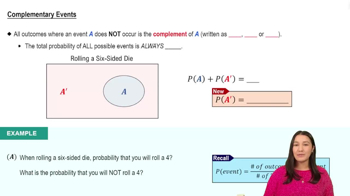
Step 3: Use the complement rule. The probability of 'at least one' liking the issue is the complement of the probability that 'none' of the two voters like the issue. Mathematically, P(at least one) = 1 - P(none).
Step 4: Calculate P(none). To find P(none), use the multiplication rule. Since the two voters are selected independently, the probability that both do not like the issue is P(A') * P(A'). Substituting the values, P(none) = 0.25 * 0.25.
Step 5: Substitute into the complement formula. Finally, substitute P(none) into the complement formula: P(at least one) = 1 - P(none). This gives the probability that at least one of the two voters would like entertainers to address social and political issues.
Verified video answer for a similar problem:This video solution was recommended by our tutors as helpful for the problem above
Video duration:
1mPlay a video:
Was this helpful?
Key Concepts
Here are the essential concepts you must grasp in order to answer the question correctly.
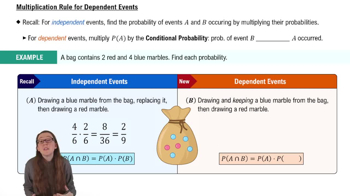
Multiplication Rule
The Multiplication Rule in probability states that the probability of two independent events both occurring is the product of their individual probabilities. This rule is essential for calculating the likelihood of multiple outcomes happening together, especially when events do not influence each other.
Recommended video:
Multiplication Rule: Dependent Events
Complementary Events
Complementary events are pairs of outcomes in a probability scenario where one event occurs if and only if the other does not. In this context, finding the probability that at least one of the two voters supports entertainers addressing social issues can be simplified by calculating the probability that neither does and subtracting it from one.
Recommended video:
Complementary Events
Probability Calculation
Probability calculation involves determining the likelihood of an event occurring, expressed as a number between 0 and 1. In this problem, the probability of a voter wanting entertainers to address issues is 0.75, and the probability of not wanting this is 0.25, which are crucial for applying the Multiplication Rule and finding the desired probability.
Recommended video:
Guided course
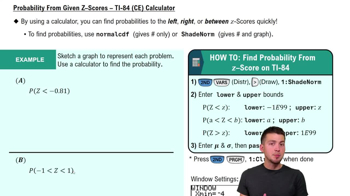
Probability From Given Z-Scores - TI-84 (CE) Calculator
Watch next
Master Multiplication Rule: Dependent Events with a bite sized video explanation from Patrick
Start learningRelated Videos
Related Practice
Multiple Choice
148
views
5
rank
