
At a certain restaurant, the distribution of wait times for customers is recorded and entered into a graphing calculator. Which of the following statistics would best describe the center of this distribution if the data are skewed to the right?
Table of contents
- 1. Intro to Stats and Collecting Data1h 14m
- 2. Describing Data with Tables and Graphs1h 55m
- 3. Describing Data Numerically2h 5m
- 4. Probability2h 16m
- 5. Binomial Distribution & Discrete Random Variables3h 6m
- 6. Normal Distribution and Continuous Random Variables2h 11m
- 7. Sampling Distributions & Confidence Intervals: Mean3h 23m
- Sampling Distribution of the Sample Mean and Central Limit Theorem19m
- Distribution of Sample Mean - Excel23m
- Introduction to Confidence Intervals15m
- Confidence Intervals for Population Mean1h 18m
- Determining the Minimum Sample Size Required12m
- Finding Probabilities and T Critical Values - Excel28m
- Confidence Intervals for Population Means - Excel25m
- 8. Sampling Distributions & Confidence Intervals: Proportion1h 25m
- 9. Hypothesis Testing for One Sample3h 29m
- 10. Hypothesis Testing for Two Samples4h 50m
- Two Proportions1h 13m
- Two Proportions Hypothesis Test - Excel28m
- Two Means - Unknown, Unequal Variance1h 3m
- Two Means - Unknown Variances Hypothesis Test - Excel12m
- Two Means - Unknown, Equal Variance15m
- Two Means - Unknown, Equal Variances Hypothesis Test - Excel9m
- Two Means - Known Variance12m
- Two Means - Sigma Known Hypothesis Test - Excel21m
- Two Means - Matched Pairs (Dependent Samples)42m
- Matched Pairs Hypothesis Test - Excel12m
- 11. Correlation1h 24m
- 12. Regression1h 50m
- 13. Chi-Square Tests & Goodness of Fit2h 21m
- 14. ANOVA1h 57m
3. Describing Data Numerically
Describing Data Numerically Using a Graphing Calculator
Problem 12.c.1d
Textbook Question
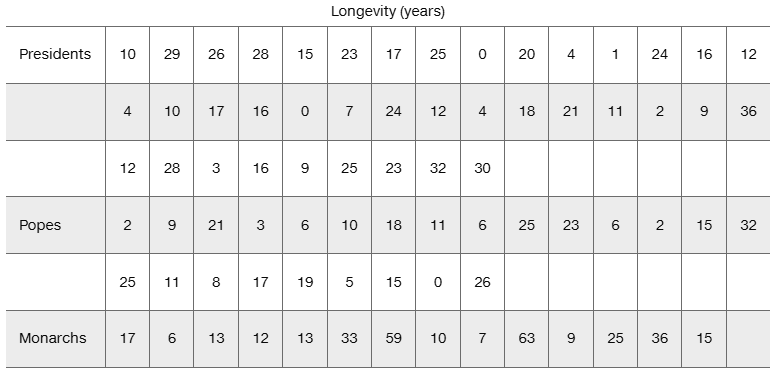
In Exercises 1–5, refer to the following list of numbers of years that deceased U.S. presidents, popes, and British monarchs lived after their inauguration, election, or coronation, respectively. (As of this writing, the last president is George H. W. Bush, the last pope is John Paul II, and the last British monarch is George VI.) Assume that the data are samples from larger populations.
[Image]
Exploring the Data Include appropriate units in all answers.
d. Are there any obvious outliers?

Verified step by step guidance1
Step 1: Organize the data for each group (Presidents, Popes, and Monarchs) into separate lists. This will help in analyzing the data for potential outliers.
Step 2: Calculate the mean (average) and standard deviation for each group. The mean is calculated as the sum of all data points divided by the number of data points, and the standard deviation measures the spread of the data around the mean.
Step 3: Identify potential outliers using the 1.5 * IQR (Interquartile Range) rule. First, calculate the quartiles (Q1 and Q3) for each group. Then, compute the IQR as Q3 - Q1. Any data point below Q1 - 1.5 * IQR or above Q3 + 1.5 * IQR is considered an outlier.
Step 4: Compare the identified outliers (if any) with the data points in the table. Highlight any values that fall significantly outside the range determined in Step 3.
Step 5: Summarize the findings, specifying which group(s) have outliers, the values of those outliers, and their implications in the context of the data (e.g., unusually long or short longevity after inauguration, election, or coronation).
Verified video answer for a similar problem:This video solution was recommended by our tutors as helpful for the problem above
Video duration:
6mPlay a video:
Was this helpful?
Key Concepts
Here are the essential concepts you must grasp in order to answer the question correctly.
Outliers
Outliers are data points that significantly differ from the other observations in a dataset. They can be unusually high or low values that may indicate variability in the measurement or may suggest a need for further investigation. Identifying outliers is crucial as they can skew statistical analyses and affect the results, leading to potentially misleading conclusions.
Recommended video:
Guided course
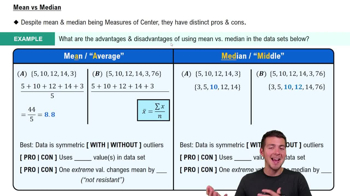
Comparing Mean vs. Median
Descriptive Statistics
Descriptive statistics summarize and describe the main features of a dataset. This includes measures such as mean, median, mode, range, and standard deviation, which provide insights into the central tendency and variability of the data. Understanding these statistics is essential for interpreting the data effectively and making informed decisions based on the analysis.
Recommended video:
Guided course
Parameters vs. Statistics
Box Plot
A box plot is a graphical representation that displays the distribution of a dataset based on five summary statistics: minimum, first quartile, median, third quartile, and maximum. It visually highlights the central tendency and variability, as well as potential outliers. Box plots are particularly useful for comparing distributions across different groups, making them a valuable tool in exploratory data analysis.
Recommended video:
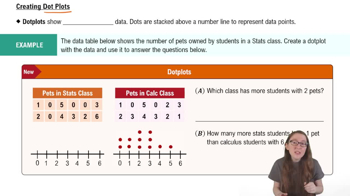
Creating Dotplots
Watch next
Master Find 5-Number Summary - TI-84 Calculator with a bite sized video explanation from Patrick
Start learningRelated Videos
Related Practice
Multiple Choice
12
views
