
Which of the following best describes where the characteristics of data, such as , , and , are typically found when using a graphing calculator?
Table of contents
- 1. Intro to Stats and Collecting Data1h 14m
- 2. Describing Data with Tables and Graphs1h 55m
- 3. Describing Data Numerically2h 5m
- 4. Probability2h 16m
- 5. Binomial Distribution & Discrete Random Variables3h 6m
- 6. Normal Distribution and Continuous Random Variables2h 11m
- 7. Sampling Distributions & Confidence Intervals: Mean3h 23m
- Sampling Distribution of the Sample Mean and Central Limit Theorem19m
- Distribution of Sample Mean - Excel23m
- Introduction to Confidence Intervals15m
- Confidence Intervals for Population Mean1h 18m
- Determining the Minimum Sample Size Required12m
- Finding Probabilities and T Critical Values - Excel28m
- Confidence Intervals for Population Means - Excel25m
- 8. Sampling Distributions & Confidence Intervals: Proportion1h 25m
- 9. Hypothesis Testing for One Sample3h 29m
- 10. Hypothesis Testing for Two Samples4h 50m
- Two Proportions1h 13m
- Two Proportions Hypothesis Test - Excel28m
- Two Means - Unknown, Unequal Variance1h 3m
- Two Means - Unknown Variances Hypothesis Test - Excel12m
- Two Means - Unknown, Equal Variance15m
- Two Means - Unknown, Equal Variances Hypothesis Test - Excel9m
- Two Means - Known Variance12m
- Two Means - Sigma Known Hypothesis Test - Excel21m
- Two Means - Matched Pairs (Dependent Samples)42m
- Matched Pairs Hypothesis Test - Excel12m
- 11. Correlation1h 24m
- 12. Regression1h 50m
- 13. Chi-Square Tests & Goodness of Fit2h 21m
- 14. ANOVA1h 57m
3. Describing Data Numerically
Describing Data Numerically Using a Graphing Calculator
Problem 6.c.2
Textbook Question
In Exercises 1 and 2, use the following wait times (minutes) at 10:00 AM for the Tower of Terror ride at Disney World (from Data Set 33 “Disney World Wait Times” in Appendix B).
35 35 20 50 95 75 45 50 30 35 30 30
Tower of Terror Wait Times
a. Find Q1, Q2 and Q3.
Verified step by step guidance1
Step 1: Organize the data in ascending order. The given wait times are: 35, 35, 20, 50, 95, 75, 45, 50, 30, 35, 30, 30. Arrange them in increasing order: 20, 30, 30, 30, 35, 35, 35, 45, 50, 50, 75, 95.
Step 2: Identify the median (Q2). The median is the middle value of the ordered data. Since there are 12 data points (even number), the median is the average of the 6th and 7th values in the ordered list. Locate the 6th and 7th values, which are both 35, and calculate their average.
Step 3: Find Q1 (the first quartile). Q1 is the median of the lower half of the data (the first 6 values in the ordered list: 20, 30, 30, 30, 35, 35). Identify the middle value of this subset, which is the average of the 3rd and 4th values.
Step 4: Find Q3 (the third quartile). Q3 is the median of the upper half of the data (the last 6 values in the ordered list: 35, 45, 50, 50, 75, 95). Identify the middle value of this subset, which is the average of the 3rd and 4th values.
Step 5: Summarize the results. Q1, Q2, and Q3 represent the first quartile, median, and third quartile, respectively. These values divide the data into four equal parts, providing insights into the distribution of the wait times.
Verified video answer for a similar problem:This video solution was recommended by our tutors as helpful for the problem above
Video duration:
3mPlay a video:
Was this helpful?
Key Concepts
Here are the essential concepts you must grasp in order to answer the question correctly.
Quartiles
Quartiles are values that divide a data set into four equal parts, each containing 25% of the data. The first quartile (Q1) is the median of the lower half of the data, the second quartile (Q2) is the overall median, and the third quartile (Q3) is the median of the upper half. These measures help summarize the distribution of the data and identify its spread.
Recommended video:
Guided course
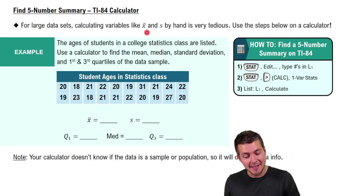
Find 5-Number Summary - TI-84 Calculator
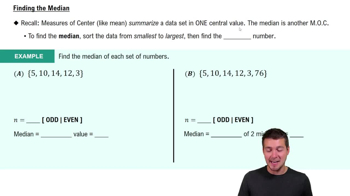
Median
The median is the middle value of a data set when it is ordered from least to greatest. If the number of observations is odd, the median is the middle number; if even, it is the average of the two middle numbers. The median is a robust measure of central tendency, less affected by outliers than the mean.
Recommended video:
Guided course
Calculating the Median
Data Set Ordering
Ordering a data set involves arranging the values in ascending or descending order, which is essential for calculating quartiles and medians. This process allows for a clear understanding of the data's distribution and helps in identifying key statistical measures, such as Q1, Q2, and Q3, which are based on the ordered values.
Recommended video:
Guided course
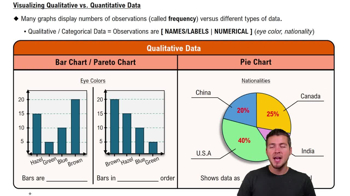
Visualizing Qualitative vs. Quantitative Data
Watch next
Master Find 5-Number Summary - TI-84 Calculator with a bite sized video explanation from Patrick
Start learningRelated Videos
Related Practice
Multiple Choice
12
views
