In Problems 5–12, find the indicated areas. For each problem, be sure to draw a standard normal curve and shade the area that is to be found. Determine the total area under the standard normal curve
c. to the left of z = –0.24 or to the right of z = 1.20
Verified step by step guidance
1
First, understand that the problem asks for the total area under the standard normal curve to the left of z = -0.24 or to the right of z = 1.20. This means we are looking for the combined probability of these two regions.
Draw a standard normal curve (a bell-shaped curve centered at 0) and mark the points z = -0.24 and z = 1.20 on the horizontal axis. Shade the area to the left of z = -0.24 and the area to the right of z = 1.20 to visualize the regions of interest.
Recall that the total area under the standard normal curve is 1. The area to the left of a z-value corresponds to the cumulative probability up to that z-value, which can be found using the standard normal distribution table or a calculator.
Find the cumulative area to the left of z = -0.24, denoted as \(P(Z < -0.24)\), and find the cumulative area to the left of z = 1.20, denoted as \(P(Z < 1.20)\). Then, calculate the area to the right of z = 1.20 by subtracting the cumulative area from 1: \(P(Z > 1.20) = 1 - P(Z < 1.20)\).
Finally, add the two areas together to get the total area: \(P(Z < -0.24) + P(Z > 1.20)\). This sum represents the probability of being either less than -0.24 or greater than 1.20 under the standard normal curve.
Verified video answer for a similar problem:
This video solution was recommended by our tutors as helpful for the problem above
Video duration:
2m
Play a video:
0 Comments
Key Concepts
Here are the essential concepts you must grasp in order to answer the question correctly.
Standard Normal Distribution
The standard normal distribution is a normal distribution with a mean of 0 and a standard deviation of 1. It is symmetric about zero, and its total area under the curve equals 1. Z-scores represent the number of standard deviations a value is from the mean.
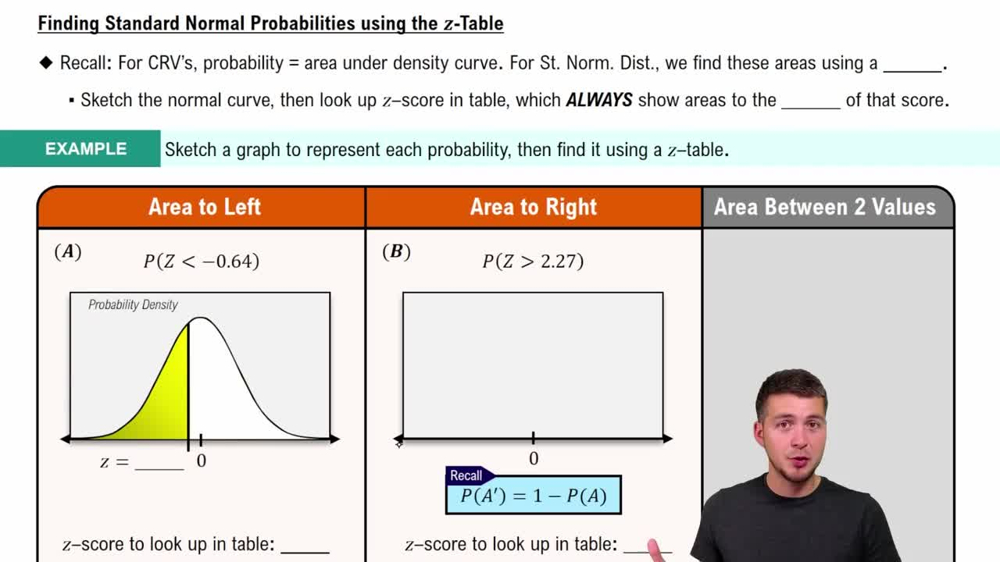
Finding Standard Normal Probabilities using z-Table
Z-Score and Area Under the Curve
A z-score indicates a position on the standard normal curve. The area to the left of a z-score corresponds to the cumulative probability up to that point. Finding areas to the left or right of z-values involves using standard normal tables or technology to determine probabilities.
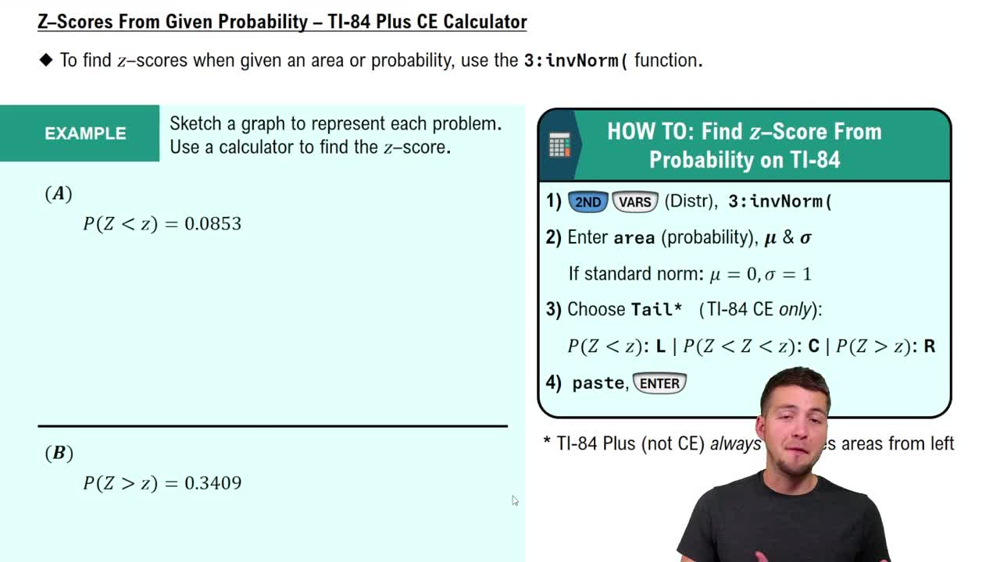
Z-Scores From Given Probability - TI-84 (CE) Calculator
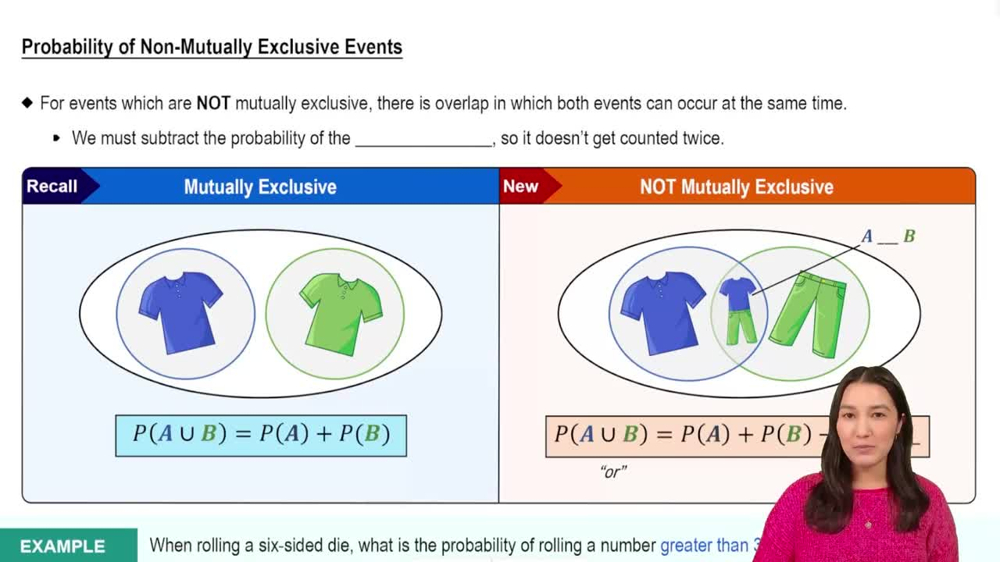
Addition Rule for Probabilities
When finding the total area for 'to the left of z = –0.24 or to the right of z = 1.20,' the addition rule applies. Since these two regions do not overlap, their probabilities can be added directly to find the combined area under the curve.

 2:04 minutes
 Verified step by step guidance
 09:47
09:47