List the steps required to conduct an experiment.
Table of contents
- 1. Intro to Stats and Collecting Data1h 14m
- 2. Describing Data with Tables and Graphs1h 55m
- 3. Describing Data Numerically2h 5m
- 4. Probability2h 16m
- 5. Binomial Distribution & Discrete Random Variables3h 6m
- 6. Normal Distribution and Continuous Random Variables2h 11m
- 7. Sampling Distributions & Confidence Intervals: Mean3h 23m
- Sampling Distribution of the Sample Mean and Central Limit Theorem19m
- Distribution of Sample Mean - Excel23m
- Introduction to Confidence Intervals15m
- Confidence Intervals for Population Mean1h 18m
- Determining the Minimum Sample Size Required12m
- Finding Probabilities and T Critical Values - Excel28m
- Confidence Intervals for Population Means - Excel25m
- 8. Sampling Distributions & Confidence Intervals: Proportion1h 25m
- 9. Hypothesis Testing for One Sample3h 29m
- 10. Hypothesis Testing for Two Samples4h 50m
- Two Proportions1h 13m
- Two Proportions Hypothesis Test - Excel28m
- Two Means - Unknown, Unequal Variance1h 3m
- Two Means - Unknown Variances Hypothesis Test - Excel12m
- Two Means - Unknown, Equal Variance15m
- Two Means - Unknown, Equal Variances Hypothesis Test - Excel9m
- Two Means - Known Variance12m
- Two Means - Sigma Known Hypothesis Test - Excel21m
- Two Means - Matched Pairs (Dependent Samples)42m
- Matched Pairs Hypothesis Test - Excel12m
- 11. Correlation1h 24m
- 12. Regression1h 50m
- 13. Chi-Square Tests & Goodness of Fit2h 21m
- 14. ANOVA1h 57m
1. Intro to Stats and Collecting Data
Intro to Stats
Problem 1.T.18d
Textbook Question
Shapely Glasses Does the shape of a glass play a role in determining the amount of time it takes to finish the drink? Researchers identified 159 male and female self-professed social drinkers. One week the subjects were given a 12 ounce beer with either a straight glass or a curved glass. A week later the subjects were given a 12 ounce beer in the other glass. The first week, subjects were given a glass and asked to consume the drink at their own pace while watching television. The time to complete the drink was measured. During the second week, the subjects were given the other shaped glass and asked to complete a computer task. Again, the time to complete the drink was measured. The type of glass given in the first week was determined randomly. The researchers found that the time to complete the drink was significantly faster for the curved glass.
What is the response variable? Is it qualitative or quantitative?
Verified step by step guidance1
Identify the response variable by determining what outcome the researchers are measuring. In this problem, the researchers are interested in the "time to complete the drink."
Recognize that the response variable is the amount of time it takes for each subject to finish their drink, which is a measurable quantity.
Since time is measured on a numerical scale (e.g., seconds or minutes), the response variable is quantitative, not qualitative.
Summarize that the response variable is the "time to complete the drink," and it is quantitative because it represents a numerical measurement.
Note that understanding the type of response variable helps in choosing the appropriate statistical methods for analysis.
Verified video answer for a similar problem:This video solution was recommended by our tutors as helpful for the problem above
Video duration:
1mPlay a video:
Was this helpful?
Key Concepts
Here are the essential concepts you must grasp in order to answer the question correctly.
Response Variable
The response variable is the main outcome measured in an experiment or study. It reflects the effect of the explanatory variable and is what researchers observe or record to assess changes. In this question, the response variable is the time it takes to finish the drink.
Recommended video:
Guided course
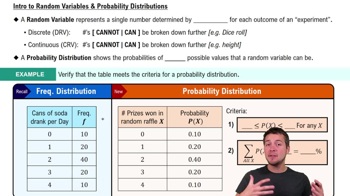
Intro to Random Variables & Probability Distributions
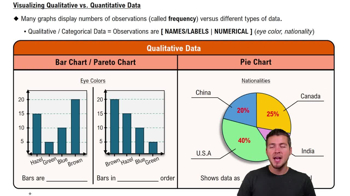
Quantitative vs. Qualitative Variables
Variables can be quantitative (numerical) or qualitative (categorical). Quantitative variables represent measurable amounts or counts, while qualitative variables describe categories or groups. Since time to complete the drink is measured in units (e.g., seconds), it is a quantitative variable.
Recommended video:
Guided course
Visualizing Qualitative vs. Quantitative Data
Experimental Design and Randomization
Randomization in experiments helps reduce bias by randomly assigning treatments to subjects. This ensures that differences in the response variable are likely due to the treatment rather than other factors. Here, the order of glass type was randomized to fairly compare drinking times.
Recommended video:
Guided course
Intro to Random Variables & Probability Distributions
Watch next
Master Introduction to Statistics Channel with a bite sized video explanation from Patrick
Start learningRelated Videos
Related Practice
Textbook Question
13
views