
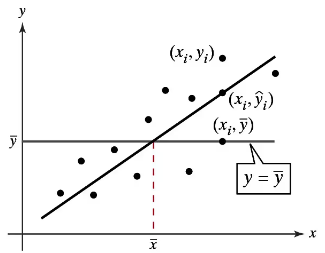
"Graphical Analysis In Exercises 1–3, use the figure. Describe the unexplained variation about a regression line in words and in symbols."
Verified step by step guidance
1
The unexplained variation about a regression line refers to the differences between the observed values (yᵢ) and the predicted values (ŷᵢ) for each data point. This difference is also known as the residual.
In the scatter plot, the residual for a data point is represented by the vertical distance between the observed value (yᵢ) and the predicted value (ŷᵢ) on the regression line.
Mathematically, the residual for the i-th data point is expressed as: rᵢ = yᵢ - ŷᵢ, where yᵢ is the observed value and ŷᵢ is the predicted value from the regression line.
The unexplained variation is the sum of the squared residuals across all data points, which is used to measure how well the regression line fits the data. This is expressed as: Σ(yᵢ - ŷᵢ)².
In words, the unexplained variation quantifies the portion of the total variation in the dependent variable (y) that is not accounted for by the regression model.
Verified video answer for a similar problem:
This video solution was recommended by our tutors as helpful for the problem above
Video duration:
3m
Play a video:
0 Comments
Key Concepts
Here are the essential concepts you must grasp in order to answer the question correctly.
Regression Line
A regression line is a statistical tool used to model the relationship between a dependent variable and one or more independent variables. It represents the best fit line through a scatter plot of data points, minimizing the distance between the points and the line. The equation of the regression line can be expressed as y = mx + b, where m is the slope and b is the y-intercept.
Residuals are the differences between the observed values and the values predicted by the regression line. They are calculated as e_i = y_i - ŷ_i, where y_i is the actual value and ŷ_i is the predicted value. Analyzing residuals helps assess the accuracy of the regression model and identify any patterns that may indicate a poor fit.
Unexplained variation refers to the portion of the total variation in the dependent variable that cannot be accounted for by the regression model. It is represented by the sum of the squared residuals and indicates how much of the variability in the data remains after fitting the model. Understanding unexplained variation is crucial for evaluating the effectiveness of the regression analysis.