"Determining Sample Size An educator wants to determine the difference between the proportion of males and females who have completed four or more years of college. What sample size should be obtained if she wishes the estimate to be within 2 percentage points with 90% confidence, assuming that b. she does not use any prior estimates?"
Verified step by step guidance
1
Identify the confidence level and the corresponding z-score. For a 90% confidence level, find the z-value \( z_{\alpha/2} \) from the standard normal distribution table, which corresponds to the middle 90% of the distribution.
Since no prior estimates of the proportions are available, use the conservative estimate for the population proportion \( p \) as 0.5. This maximizes the product \( p(1-p) \) and thus the required sample size, ensuring the estimate is within the desired margin of error regardless of the true proportion.
Determine the margin of error \( E \) in decimal form. Since the desired margin is 2 percentage points, convert this to \( E = 0.02 \).
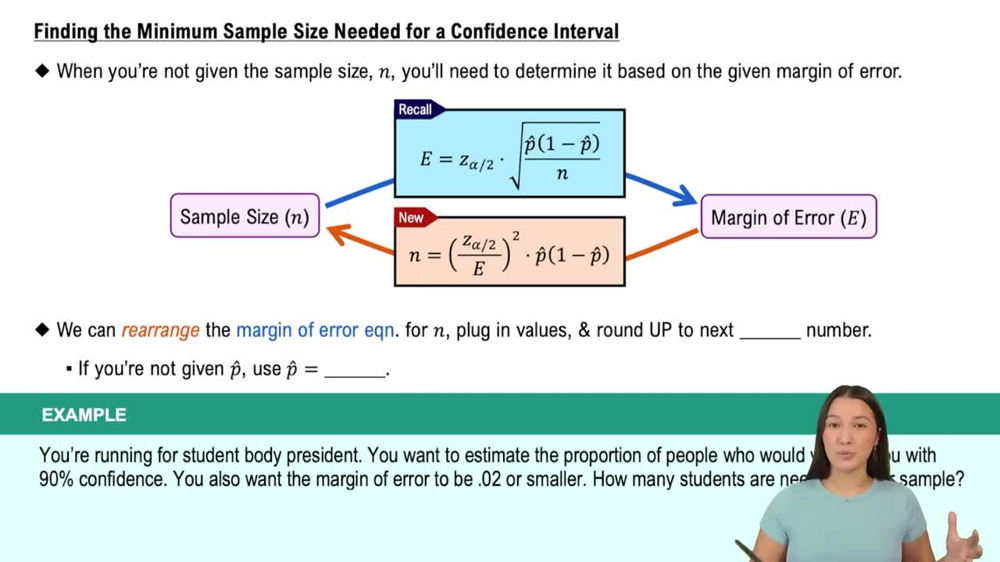
Use the formula for the sample size \( n \) when estimating a proportion with a specified margin of error and confidence level without prior estimates:
\[ n = \left( \frac{z_{\alpha/2}}{E} \right)^2 \times p(1-p) \]
Substitute \( p = 0.5 \) into the formula.
Calculate the value inside the formula step-by-step: square the z-score, divide by the square of the margin of error, and multiply by \( p(1-p) \). This will give the minimum sample size needed to estimate the difference between proportions within the specified margin of error and confidence level.
Verified video answer for a similar problem:
This video solution was recommended by our tutors as helpful for the problem above
Video duration:
5m
Play a video:
0 Comments
Key Concepts
Here are the essential concepts you must grasp in order to answer the question correctly.
Sample Size Determination for Proportions
Sample size determination involves calculating the number of observations needed to estimate a population parameter with a specified margin of error and confidence level. For proportions, the formula incorporates the desired margin of error, confidence level, and an estimate of the population proportion. When no prior estimate is available, a conservative value is used to maximize sample size.
The margin of error defines the maximum expected difference between the sample estimate and the true population parameter. The confidence level represents the probability that this interval contains the true parameter. Higher confidence levels or smaller margins of error require larger sample sizes to ensure precision.
Using Conservative Estimates in Sample Size Calculation
When no prior proportion estimate is available, the most conservative approach assumes the proportion is 0.5, which maximizes the product p(1-p) and thus the required sample size. This ensures the sample size is sufficient regardless of the true proportion, providing a safe estimate for planning.