Acceptance Sampling Suppose that you have just received a shipment of 100 televisions. Although you don’t know this, 6 are defective. To determine whether you will accept the shipment, you randomly select 5 televisions and test them. If all 5 televisions work, you accept the shipment; otherwise, the shipment is rejected. What is the probability of accepting the shipment?
Table of contents
- 1. Intro to Stats and Collecting Data1h 14m
- 2. Describing Data with Tables and Graphs1h 55m
- 3. Describing Data Numerically2h 5m
- 4. Probability2h 16m
- 5. Binomial Distribution & Discrete Random Variables3h 6m
- 6. Normal Distribution and Continuous Random Variables2h 11m
- 7. Sampling Distributions & Confidence Intervals: Mean3h 23m
- Sampling Distribution of the Sample Mean and Central Limit Theorem19m
- Distribution of Sample Mean - Excel23m
- Introduction to Confidence Intervals15m
- Confidence Intervals for Population Mean1h 18m
- Determining the Minimum Sample Size Required12m
- Finding Probabilities and T Critical Values - Excel28m
- Confidence Intervals for Population Means - Excel25m
- 8. Sampling Distributions & Confidence Intervals: Proportion2h 10m
- 9. Hypothesis Testing for One Sample5h 8m
- Steps in Hypothesis Testing1h 6m
- Performing Hypothesis Tests: Means1h 4m
- Hypothesis Testing: Means - Excel42m
- Performing Hypothesis Tests: Proportions37m
- Hypothesis Testing: Proportions - Excel27m
- Performing Hypothesis Tests: Variance12m
- Critical Values and Rejection Regions28m
- Link Between Confidence Intervals and Hypothesis Testing12m
- Type I & Type II Errors16m
- 10. Hypothesis Testing for Two Samples5h 37m
- Two Proportions1h 13m
- Two Proportions Hypothesis Test - Excel28m
- Two Means - Unknown, Unequal Variance1h 3m
- Two Means - Unknown Variances Hypothesis Test - Excel12m
- Two Means - Unknown, Equal Variance15m
- Two Means - Unknown, Equal Variances Hypothesis Test - Excel9m
- Two Means - Known Variance12m
- Two Means - Sigma Known Hypothesis Test - Excel21m
- Two Means - Matched Pairs (Dependent Samples)42m
- Matched Pairs Hypothesis Test - Excel12m
- Two Variances and F Distribution29m
- Two Variances - Graphing Calculator16m
- 11. Correlation1h 24m
- 12. Regression3h 33m
- Linear Regression & Least Squares Method26m
- Residuals12m
- Coefficient of Determination12m
- Regression Line Equation and Coefficient of Determination - Excel8m
- Finding Residuals and Creating Residual Plots - Excel11m
- Inferences for Slope31m
- Enabling Data Analysis Toolpak1m
- Regression Readout of the Data Analysis Toolpak - Excel21m
- Prediction Intervals13m
- Prediction Intervals - Excel19m
- Multiple Regression - Excel29m
- Quadratic Regression15m
- Quadratic Regression - Excel10m
- 13. Chi-Square Tests & Goodness of Fit2h 21m
- 14. ANOVA2h 28m
5. Binomial Distribution & Discrete Random Variables
Hypergeometric Distribution
Problem 6.2.15
Textbook Question
In Problems 7–16, determine which of the following probability experiments represents a binomial experiment. If the probability experiment is not a binomial experiment, state why.
One hundred randomly selected U.S. parents with at least one child under the age of 18 are surveyed and asked if they have ever spanked their child. The number of parents who have spanked their child is recorded.
Verified step by step guidance1
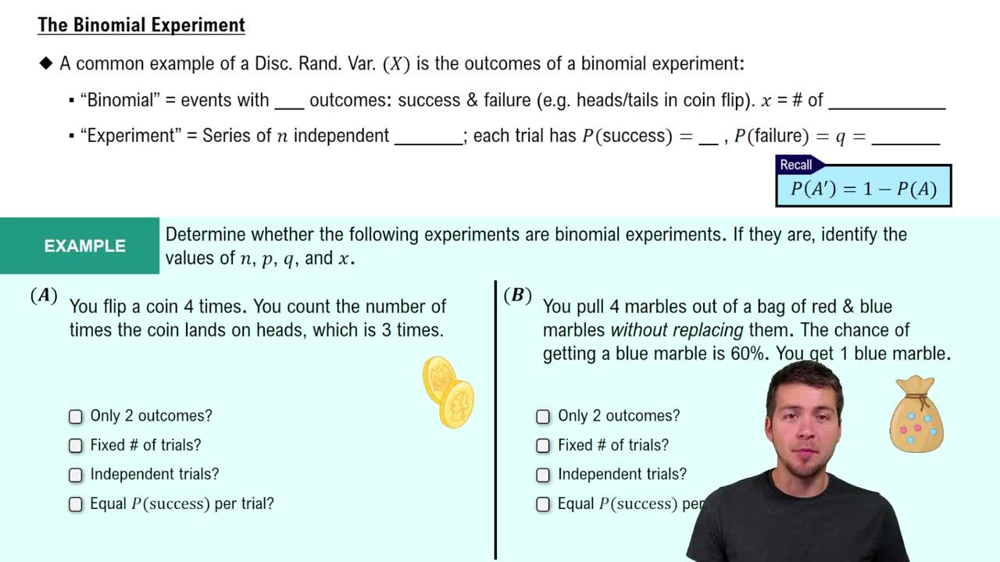
Recall the definition of a binomial experiment: it must satisfy four conditions: (1) a fixed number of trials, (2) each trial has only two possible outcomes (success or failure), (3) the trials are independent, and (4) the probability of success is the same for each trial.
Identify the trials in the given experiment: each trial corresponds to asking one parent whether they have ever spanked their child, so there are 100 trials (parents surveyed).
Check the outcomes for each trial: the response is either 'have spanked' (success) or 'have not spanked' (failure), so there are exactly two possible outcomes per trial.
Consider the independence of trials: since the parents are randomly selected, we can assume the responses are independent of each other.
Evaluate if the probability of success is constant: assuming the probability that any randomly selected parent has spanked their child is the same across all parents, this condition is met. Therefore, this experiment satisfies all binomial conditions.
Verified video answer for a similar problem:This video solution was recommended by our tutors as helpful for the problem above
Video duration:
4mPlay a video:
Key Concepts
Here are the essential concepts you must grasp in order to answer the question correctly.
Binomial Experiment Criteria
A binomial experiment consists of a fixed number of independent trials, each with only two possible outcomes (success or failure), and a constant probability of success. Understanding these criteria helps determine if a given experiment fits the binomial model.
Recommended video:
Guided course
The Binomial Experiment
Independence of Trials
Independence means the outcome of one trial does not affect the outcome of another. In surveys or experiments, ensuring independence is crucial because dependent trials violate binomial assumptions and affect probability calculations.
Recommended video:
Guided course
Independence Test
Fixed Number of Trials and Constant Probability
The number of trials must be predetermined and fixed, and the probability of success must remain the same for each trial. This ensures the binomial distribution applies, as varying probabilities or trial counts invalidate the model.
Recommended video:
Introduction to Probability
Watch next
Master Introduction to the Hypergeometric Distribution with a bite sized video explanation from Patrick
Start learningRelated Videos
Related Practice
Textbook Question
13
views