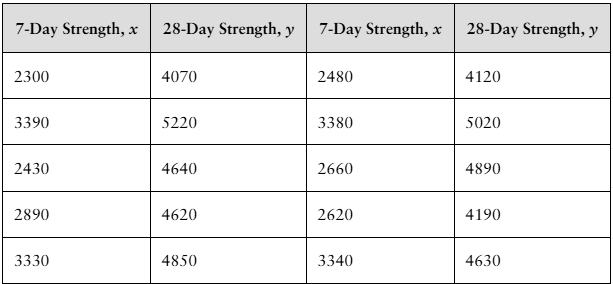
[DATA] Concrete [See Problem 15 in Section 12.3] As concrete cures, it gains strength. The following data represent the 7-day and 28-day strength (in pounds per square inch) of a certain type of concrete: b. Suppose a researcher wanted to determine if there is a linear relation between 7-day strength and 28-day strength. What would be the null and alternative hypotheses?
Verified step by step guidance
1
Step 1: Identify the variables involved. Here, the 7-day strength is the independent variable \(x\), and the 28-day strength is the dependent variable \(y\).
Step 2: Understand the goal. The researcher wants to test if there is a linear relationship between \(x\) and \(y\). This involves testing the correlation or the slope of the regression line between these two variables.
Step 3: Formulate the null hypothesis (\(H_0\)). The null hypothesis typically states that there is no linear relationship between the variables. In terms of the population correlation coefficient \(\rho\), this is \(H_0: \rho = 0\).
Step 4: Formulate the alternative hypothesis (\(H_a\)). The alternative hypothesis states that there is a linear relationship, meaning the correlation coefficient is not zero. This is \(H_a: \rho \neq 0\).
Step 5: These hypotheses can also be expressed in terms of the slope \(\beta_1\) of the regression line: \(H_0: \beta_1 = 0\) (no linear relationship) versus \(H_a: \beta_1 \neq 0\) (linear relationship exists).
Verified video answer for a similar problem:
This video solution was recommended by our tutors as helpful for the problem above
Video duration:
1m
Play a video:
0 Comments
Key Concepts
Here are the essential concepts you must grasp in order to answer the question correctly.
Null and Alternative Hypotheses in Linear Regression
In testing for a linear relationship between two variables, the null hypothesis (H0) states that there is no linear association (the slope is zero), while the alternative hypothesis (H1) states that a linear relationship exists (the slope is not zero). These hypotheses guide the statistical test to determine if the observed data provide enough evidence to conclude a linear relationship.
Paired data consist of two related measurements taken on the same subjects, such as 7-day and 28-day concrete strengths. Understanding that each pair corresponds to the same sample is crucial for analyzing the relationship between variables, as it ensures that comparisons and correlations are meaningful and valid.
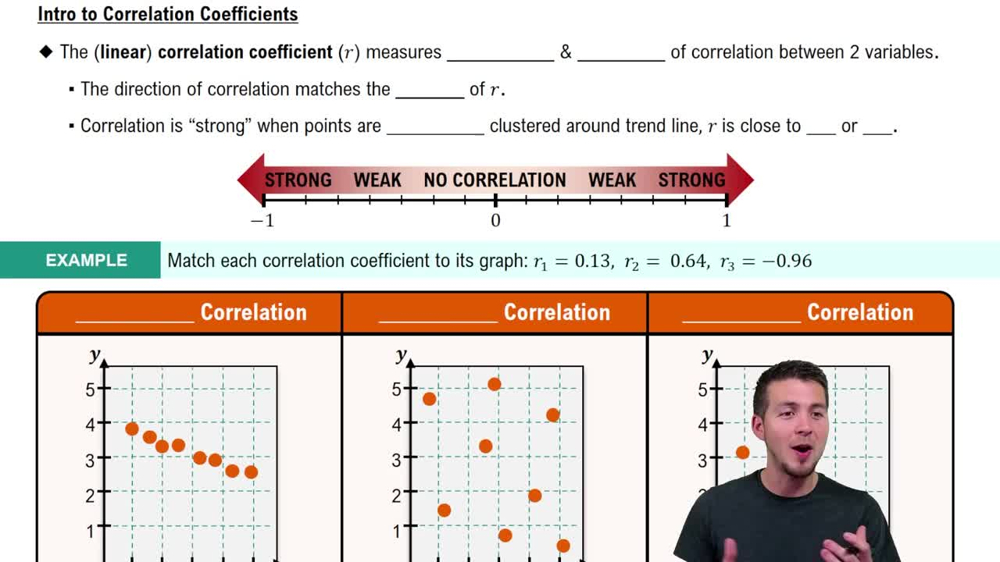
A linear relationship between two variables means that changes in one variable are associated with proportional changes in the other, often modeled by a straight line. Correlation measures the strength and direction of this linear association, which helps in assessing whether a linear model is appropriate for the data.