Given a residual plot that shows a random scatter of points around the horizontal axis with no apparent pattern, which conclusion is most appropriate about the use of a linear model?
Table of contents
- 1. Intro to Stats and Collecting Data1h 14m
- 2. Describing Data with Tables and Graphs1h 55m
- 3. Describing Data Numerically2h 5m
- 4. Probability2h 16m
- 5. Binomial Distribution & Discrete Random Variables3h 6m
- 6. Normal Distribution and Continuous Random Variables2h 11m
- 7. Sampling Distributions & Confidence Intervals: Mean3h 23m
- Sampling Distribution of the Sample Mean and Central Limit Theorem19m
- Distribution of Sample Mean - Excel23m
- Introduction to Confidence Intervals15m
- Confidence Intervals for Population Mean1h 18m
- Determining the Minimum Sample Size Required12m
- Finding Probabilities and T Critical Values - Excel28m
- Confidence Intervals for Population Means - Excel25m
- 8. Sampling Distributions & Confidence Intervals: Proportion1h 25m
- 9. Hypothesis Testing for One Sample3h 29m
- 10. Hypothesis Testing for Two Samples4h 50m
- Two Proportions1h 13m
- Two Proportions Hypothesis Test - Excel28m
- Two Means - Unknown, Unequal Variance1h 3m
- Two Means - Unknown Variances Hypothesis Test - Excel12m
- Two Means - Unknown, Equal Variance15m
- Two Means - Unknown, Equal Variances Hypothesis Test - Excel9m
- Two Means - Known Variance12m
- Two Means - Sigma Known Hypothesis Test - Excel21m
- Two Means - Matched Pairs (Dependent Samples)42m
- Matched Pairs Hypothesis Test - Excel12m
- 11. Correlation1h 24m
- 12. Regression1h 50m
- 13. Chi-Square Tests & Goodness of Fit2h 21m
- 14. ANOVA1h 57m
11. Correlation
Scatterplots & Intro to Correlation
Problem 4.1.22
Textbook Question
Name the Relation, Part II For each of the following statements, explain whether you think the variables will have positive correlation, negative correlation, or no correlation. Support your opinion.
a. Number of cigarettes smoked by a pregnant woman each week and birth weight of her baby
b. Years of education and annual salary
c. Number of doctors on staff at a hospital and number of administrators on staff
d. Head circumference and IQ
e. Number of moviegoers and movie ticket price
Verified step by step guidance1
Step 1: Understand the concept of correlation. Correlation measures the strength and direction of a linear relationship between two variables. A positive correlation means as one variable increases, the other tends to increase. A negative correlation means as one variable increases, the other tends to decrease. No correlation means there is no apparent linear relationship between the variables.
Step 2: For part (a), consider the relationship between the number of cigarettes smoked by a pregnant woman each week and the birth weight of her baby. Think about how smoking might affect birth weight and whether this suggests a positive, negative, or no correlation.
Step 3: For part (b), analyze the relationship between years of education and annual salary. Reflect on how education level might influence salary and what type of correlation this implies.
Step 4: For part (c), examine the relationship between the number of doctors on staff at a hospital and the number of administrators on staff. Consider whether these two staffing numbers tend to increase together, decrease together, or show no consistent pattern.
Step 5: For parts (d) and (e), apply similar reasoning: (d) assess the relationship between head circumference and IQ, considering biological and psychological factors; (e) evaluate the relationship between the number of moviegoers and movie ticket price, thinking about economic principles like demand and price.
Verified video answer for a similar problem:This video solution was recommended by our tutors as helpful for the problem above
Video duration:
1mPlay a video:
Was this helpful?
Key Concepts
Here are the essential concepts you must grasp in order to answer the question correctly.
Correlation
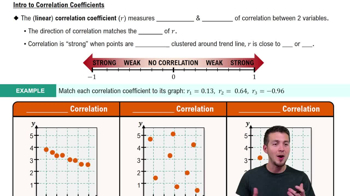
Correlation measures the strength and direction of a linear relationship between two variables. It ranges from -1 to 1, where positive values indicate that as one variable increases, the other tends to increase, negative values indicate an inverse relationship, and values near zero suggest no linear relationship.
Recommended video:
Guided course
Correlation Coefficient
Positive, Negative, and No Correlation
Positive correlation means both variables move in the same direction, negative correlation means they move in opposite directions, and no correlation means there is no predictable linear relationship. Understanding these helps interpret how variables relate in real-world contexts, such as health or economics.
Recommended video:
Guided course
Correlation Coefficient
Contextual Interpretation of Correlation
Interpreting correlation requires considering the context and nature of variables, as some relationships may be influenced by external factors or may not be linear. For example, social or biological factors can explain why certain variables correlate positively or negatively, guiding meaningful conclusions.
Recommended video:
Guided course
Correlation Coefficient
Watch next
Master Scatterplots & Intro to Correlation with a bite sized video explanation from Patrick
Start learningRelated Videos
Related Practice
Multiple Choice
12
views