Given the following correlation coefficients, which value of would most likely correspond to a scatterplot showing a strong negative linear relationship between two variables?
Table of contents
- 1. Intro to Stats and Collecting Data1h 14m
- 2. Describing Data with Tables and Graphs1h 55m
- 3. Describing Data Numerically2h 5m
- 4. Probability2h 16m
- 5. Binomial Distribution & Discrete Random Variables3h 6m
- 6. Normal Distribution and Continuous Random Variables2h 11m
- 7. Sampling Distributions & Confidence Intervals: Mean3h 23m
- Sampling Distribution of the Sample Mean and Central Limit Theorem19m
- Distribution of Sample Mean - Excel23m
- Introduction to Confidence Intervals15m
- Confidence Intervals for Population Mean1h 18m
- Determining the Minimum Sample Size Required12m
- Finding Probabilities and T Critical Values - Excel28m
- Confidence Intervals for Population Means - Excel25m
- 8. Sampling Distributions & Confidence Intervals: Proportion1h 25m
- 9. Hypothesis Testing for One Sample3h 29m
- 10. Hypothesis Testing for Two Samples4h 50m
- Two Proportions1h 13m
- Two Proportions Hypothesis Test - Excel28m
- Two Means - Unknown, Unequal Variance1h 3m
- Two Means - Unknown Variances Hypothesis Test - Excel12m
- Two Means - Unknown, Equal Variance15m
- Two Means - Unknown, Equal Variances Hypothesis Test - Excel9m
- Two Means - Known Variance12m
- Two Means - Sigma Known Hypothesis Test - Excel21m
- Two Means - Matched Pairs (Dependent Samples)42m
- Matched Pairs Hypothesis Test - Excel12m
- 11. Correlation1h 24m
- 12. Regression1h 50m
- 13. Chi-Square Tests & Goodness of Fit2h 21m
- 14. ANOVA1h 57m
11. Correlation
Scatterplots & Intro to Correlation
Problem 4.1.44
Textbook Question
Obesity In a study published in the Journal of the American Medical Association, researchers found that the length of time a mother breast-feeds is negatively associated with the likelihood a child is obese. In an interview, the head investigator stated, “It’s not clear whether breast milk has obesity-preventing properties or the women who are breast-feeding are less likely to have obese kids because they are less likely to be obese themselves.” Using the researcher’s statement, explain what might be wrong with concluding that breast-feeding prevents obesity. Identify some lurking variables in the study. 201
Verified step by step guidance1
Step 1: Understand the concept of causation versus correlation. The study finds a negative association between breast-feeding duration and child obesity, but this does not necessarily mean breast-feeding causes lower obesity rates.
Step 2: Recognize the potential problem of confounding variables, also known as lurking variables, which are factors that influence both the independent variable (breast-feeding) and the dependent variable (child obesity) and can create a misleading association.
Step 3: Identify possible lurking variables mentioned by the researcher, such as the mother's own obesity status, which might affect both her likelihood to breast-feed and the child's risk of obesity.
Step 4: Explain that without controlling for these lurking variables, the observed association might be due to these other factors rather than a direct effect of breast-feeding on obesity prevention.
Step 5: Conclude that to establish a causal relationship, further studies such as randomized controlled trials or studies that adjust for confounding variables are needed to isolate the effect of breast-feeding on child obesity.
Verified video answer for a similar problem:This video solution was recommended by our tutors as helpful for the problem above
Video duration:
4mPlay a video:
Was this helpful?
Key Concepts
Here are the essential concepts you must grasp in order to answer the question correctly.
Correlation vs. Causation
Correlation means two variables are related, but it does not prove that one causes the other. In the study, breast-feeding duration is linked to obesity rates, but this does not confirm that breast-feeding directly prevents obesity. Other factors might influence both variables, so concluding causation without further evidence is misleading.
Recommended video:
Guided course
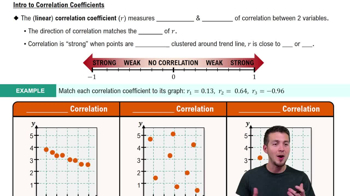
Correlation Coefficient
Lurking Variables
Lurking variables are hidden factors that affect both the independent and dependent variables, potentially confounding results. In this study, maternal obesity or lifestyle could influence both breast-feeding habits and child obesity risk, making it unclear if breast-feeding itself impacts obesity or if these lurking variables drive the association.
Recommended video:
Guided course
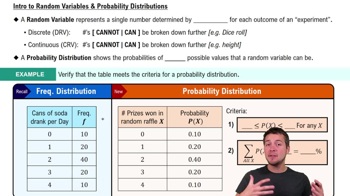
Intro to Random Variables & Probability Distributions
Confounding Variables and Bias
Confounding variables distort the apparent relationship between studied variables by being related to both. Bias can arise if these confounders are not controlled. For example, socioeconomic status or maternal health behaviors might confound the link between breast-feeding and child obesity, leading to incorrect conclusions if not accounted for.
Recommended video:
Guided course
Intro to Random Variables & Probability Distributions
Watch next
Master Scatterplots & Intro to Correlation with a bite sized video explanation from Patrick
Start learningRelated Videos
Related Practice
Multiple Choice
12
views