
Graphical Analysis In Exercises 11–14, determine whether there is a perfect positive linear correlation, a strong positive linear correlation, a perfect negative linear correlation, a strong negative linear correlation, or no linear correlation between the variables.
Table of contents
- 1. Intro to Stats and Collecting Data1h 14m
- 2. Describing Data with Tables and Graphs1h 55m
- 3. Describing Data Numerically2h 5m
- 4. Probability2h 16m
- 5. Binomial Distribution & Discrete Random Variables3h 6m
- 6. Normal Distribution and Continuous Random Variables2h 11m
- 7. Sampling Distributions & Confidence Intervals: Mean3h 23m
- Sampling Distribution of the Sample Mean and Central Limit Theorem19m
- Distribution of Sample Mean - Excel23m
- Introduction to Confidence Intervals15m
- Confidence Intervals for Population Mean1h 18m
- Determining the Minimum Sample Size Required12m
- Finding Probabilities and T Critical Values - Excel28m
- Confidence Intervals for Population Means - Excel25m
- 8. Sampling Distributions & Confidence Intervals: Proportion1h 25m
- 9. Hypothesis Testing for One Sample3h 29m
- 10. Hypothesis Testing for Two Samples4h 50m
- Two Proportions1h 13m
- Two Proportions Hypothesis Test - Excel28m
- Two Means - Unknown, Unequal Variance1h 3m
- Two Means - Unknown Variances Hypothesis Test - Excel12m
- Two Means - Unknown, Equal Variance15m
- Two Means - Unknown, Equal Variances Hypothesis Test - Excel9m
- Two Means - Known Variance12m
- Two Means - Sigma Known Hypothesis Test - Excel21m
- Two Means - Matched Pairs (Dependent Samples)42m
- Matched Pairs Hypothesis Test - Excel12m
- 11. Correlation1h 24m
- 12. Regression1h 50m
- 13. Chi-Square Tests & Goodness of Fit2h 21m
- 14. ANOVA1h 57m
11. Correlation
Scatterplots & Intro to Correlation
Problem 9.1.38c
Textbook Question
Writing Use an appropriate research source to find a real-life data set with the indicated cause-and-effect relationship. Write a paragraph describing each variable and explain why you think the variables have the indicated cause-and-effect relationship.
c. Coincidence: The relationship between the variables is a coincidence.
Verified step by step guidance1
Identify a real-life data set where two variables appear to have a relationship, but the connection is coincidental rather than causal. For example, you might find a data set showing a correlation between ice cream sales and shark attacks.
Define the two variables in the data set. For instance, Variable 1 could be 'Ice Cream Sales' (measured in dollars or units sold), and Variable 2 could be 'Number of Shark Attacks' (measured as a count).
Explain the observed relationship between the two variables. For example, you might note that as ice cream sales increase, the number of shark attacks also increases.
Discuss why the relationship is coincidental and not causal. In this example, you could explain that both variables are influenced by a third factor, such as temperature or seasonality, which causes both ice cream sales and beach activity (leading to shark attacks) to increase simultaneously.
Write a paragraph summarizing the variables, their definitions, the observed relationship, and why the relationship is coincidental. Ensure the explanation is clear and concise, emphasizing the lack of direct causation between the variables.
Verified video answer for a similar problem:This video solution was recommended by our tutors as helpful for the problem above
Video duration:
1mPlay a video:
Was this helpful?
Key Concepts
Here are the essential concepts you must grasp in order to answer the question correctly.
Cause-and-Effect Relationship
A cause-and-effect relationship indicates that one variable directly influences another. In statistics, this is often established through experimental or observational studies where changes in an independent variable lead to changes in a dependent variable. Understanding this relationship is crucial for determining whether a correlation is meaningful or merely coincidental.
Recommended video:
Guided course
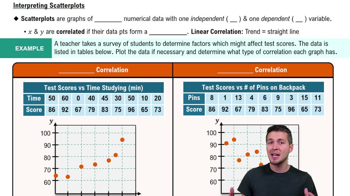
Scatterplots & Intro to Correlation
Correlation vs. Causation
Correlation refers to a statistical association between two variables, while causation implies that one variable directly affects the other. It is essential to distinguish between the two, as a strong correlation does not necessarily mean that one variable causes the other. This concept is vital when analyzing data sets to avoid misinterpretation of results.
Recommended video:
Guided course
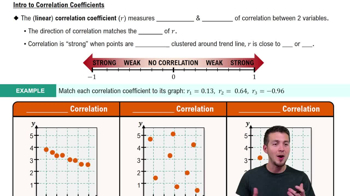
Correlation Coefficient
Coincidence
Coincidence occurs when two variables appear to be related but are actually linked by chance rather than a direct causal relationship. This can happen due to random fluctuations in data or the presence of confounding variables. Recognizing coincidence is important in statistical analysis to prevent drawing incorrect conclusions from data.
Recommended video:
Guided course
Scatterplots & Intro to Correlation
Watch next
Master Scatterplots & Intro to Correlation with a bite sized video explanation from Patrick
Start learningRelated Videos
Related Practice
Textbook Question
17
views
