
Graphical Analysis In Exercises 11–14, determine whether there is a perfect positive linear correlation, a strong positive linear correlation, a perfect negative linear correlation, a strong negative linear correlation, or no linear correlation between the variables.
Table of contents
- 1. Intro to Stats and Collecting Data1h 14m
- 2. Describing Data with Tables and Graphs1h 55m
- 3. Describing Data Numerically2h 5m
- 4. Probability2h 16m
- 5. Binomial Distribution & Discrete Random Variables3h 6m
- 6. Normal Distribution and Continuous Random Variables2h 11m
- 7. Sampling Distributions & Confidence Intervals: Mean3h 23m
- Sampling Distribution of the Sample Mean and Central Limit Theorem19m
- Distribution of Sample Mean - Excel23m
- Introduction to Confidence Intervals15m
- Confidence Intervals for Population Mean1h 18m
- Determining the Minimum Sample Size Required12m
- Finding Probabilities and T Critical Values - Excel28m
- Confidence Intervals for Population Means - Excel25m
- 8. Sampling Distributions & Confidence Intervals: Proportion1h 25m
- 9. Hypothesis Testing for One Sample3h 29m
- 10. Hypothesis Testing for Two Samples4h 50m
- Two Proportions1h 13m
- Two Proportions Hypothesis Test - Excel28m
- Two Means - Unknown, Unequal Variance1h 3m
- Two Means - Unknown Variances Hypothesis Test - Excel12m
- Two Means - Unknown, Equal Variance15m
- Two Means - Unknown, Equal Variances Hypothesis Test - Excel9m
- Two Means - Known Variance12m
- Two Means - Sigma Known Hypothesis Test - Excel21m
- Two Means - Matched Pairs (Dependent Samples)42m
- Matched Pairs Hypothesis Test - Excel12m
- 11. Correlation1h 24m
- 12. Regression1h 50m
- 13. Chi-Square Tests & Goodness of Fit2h 21m
- 14. ANOVA1h 57m
11. Correlation
Scatterplots & Intro to Correlation
Problem 9.1.38a
Textbook Question
Writing Use an appropriate research source to find a real-life data set with the indicated cause-and-effect relationship. Write a paragraph describing each variable and explain why you think the variables have the indicated cause-and-effect relationship.
a. Direct Cause-and-Effect: Changes in one variable cause changes in the other variable.
Verified step by step guidance1
Step 1: Identify a real-life data set that demonstrates a direct cause-and-effect relationship. For example, consider a data set that examines the relationship between the number of hours studied (independent variable) and test scores (dependent variable).
Step 2: Define the variables in the data set. For instance, the independent variable could be 'hours studied,' which represents the amount of time a student spends preparing for an exam, and the dependent variable could be 'test scores,' which represent the performance outcome on the exam.
Step 3: Explain why the relationship is direct cause-and-effect. In this case, an increase in the number of hours studied is likely to directly cause an improvement in test scores, assuming other factors remain constant. This is because studying more provides better preparation and understanding of the material.
Step 4: Write a paragraph describing the variables and their relationship. For example: 'The data set examines the relationship between hours studied and test scores. The independent variable, hours studied, measures the time spent preparing for an exam, while the dependent variable, test scores, measures the performance outcome. This relationship is a direct cause-and-effect because increased study time directly impacts the understanding of the material, leading to higher test scores.'
Step 5: Ensure the explanation is clear and concise, and verify that the data set supports the direct cause-and-effect relationship. If necessary, include a brief mention of any assumptions or limitations, such as the exclusion of external factors like test anxiety or prior knowledge.
Verified video answer for a similar problem:This video solution was recommended by our tutors as helpful for the problem above
Video duration:
2mPlay a video:
Was this helpful?
Key Concepts
Here are the essential concepts you must grasp in order to answer the question correctly.
Cause-and-Effect Relationship
A cause-and-effect relationship occurs when one variable (the cause) directly influences another variable (the effect). This means that changes in the cause lead to changes in the effect, establishing a clear directional link. Understanding this relationship is crucial for analyzing data sets, as it helps in identifying how variables interact and the nature of their connection.
Recommended video:
Guided course
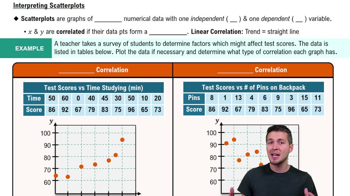
Scatterplots & Intro to Correlation
Independent and Dependent Variables
In a cause-and-effect scenario, the independent variable is the one that is manipulated or changed to observe its effect on the dependent variable, which is the outcome being measured. For example, if studying the effect of study hours (independent) on test scores (dependent), the independent variable is expected to influence the dependent variable. Recognizing these roles is essential for proper data analysis.
Recommended video:
Guided course
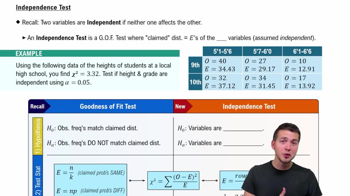
Independence Test
Data Set Analysis
Data set analysis involves examining and interpreting data to uncover patterns, relationships, and insights. When looking for a real-life data set that demonstrates a cause-and-effect relationship, it is important to assess the quality and relevance of the data, ensuring it accurately reflects the variables in question. This analysis helps in validating the proposed relationships and drawing meaningful conclusions.
Recommended video:
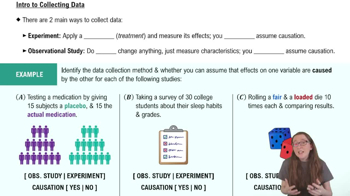
Introduction to Collecting Data
Watch next
Master Scatterplots & Intro to Correlation with a bite sized video explanation from Patrick
Start learningRelated Videos
Related Practice
Textbook Question
21
views
