
Textbook Question
Convert each radian measure to degrees. See Examples 2(a) and 2(b). 15π
857
views

 Verified step by step guidance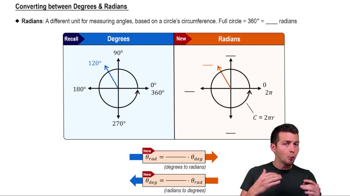
 5:04
5:04 5:04
5:04 4:45
4:45Convert each radian measure to degrees. See Examples 2(a) and 2(b). 15π
Find the area of a sector of a circle having radius r and central angle θ. Express answers to the nearest tenth. See Example 5. r = 29.2 m, θ = 5π/6 radians
Convert each degree measure to radians. If applicable, round to the nearest thousandth. See Example 1(c).
139° 10'
Find a calculator approximation to four decimal places for each circular function value. cos (-0.2443)
Convert each degree measure to radians. If applicable, round to the nearest thousandth. See Example 1(c).
39°
Find a calculator approximation to four decimal places for each circular function value.
sin 1.0472