In Exercises 39–46, find the unit vector that has the same direction as the vector v.
v = 4i - 2j
Verified step by step guidance
1
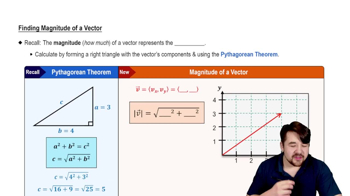
Calculate the magnitude of the vector \( \mathbf{v} = 4\mathbf{i} - 2\mathbf{j} \) using the formula \( \|\mathbf{v}\| = \sqrt{a^2 + b^2} \), where \( a = 4 \) and \( b = -2 \).
Substitute the values into the formula: \( \|\mathbf{v}\| = \sqrt{4^2 + (-2)^2} \).
Simplify the expression under the square root: \( \|\mathbf{v}\| = \sqrt{16 + 4} \).
Calculate the square root: \( \|\mathbf{v}\| = \sqrt{20} \).
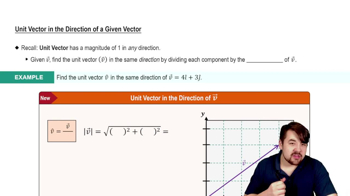
Divide each component of the vector \( \mathbf{v} \) by its magnitude to find the unit vector: \( \mathbf{u} = \frac{1}{\|\mathbf{v}\|}(4\mathbf{i} - 2\mathbf{j}) \).
Verified video answer for a similar problem:
This video solution was recommended by our tutors as helpful for the problem above
Video duration:
2m
Play a video:
Key Concepts
Here are the essential concepts you must grasp in order to answer the question correctly.
Unit Vector
A unit vector is a vector that has a magnitude of one and indicates direction. To find a unit vector in the same direction as a given vector, you divide the vector by its magnitude. This process normalizes the vector, preserving its direction while scaling its length to one.
The magnitude of a vector is a measure of its length in space, calculated using the formula √(x² + y²) for a 2D vector represented as v = xi + yj. For the vector v = 4i - 2j, the magnitude is √(4² + (-2)²) = √(16 + 4) = √20, which is essential for determining the unit vector.
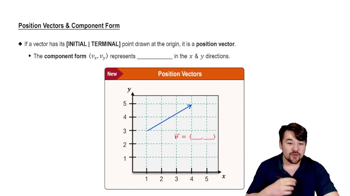
Vectors in two-dimensional space can be expressed in terms of their components along the x-axis and y-axis, typically written as v = xi + yj. In the vector v = 4i - 2j, the components are 4 (along the x-axis) and -2 (along the y-axis). Understanding these components is crucial for calculating both the magnitude and the unit vector.


 2:27 minutes
 Verified step by step guidance
 04:04
04:04