Graph each function over a one-period interval. y = -2 cos x
Verified step by step guidance
1
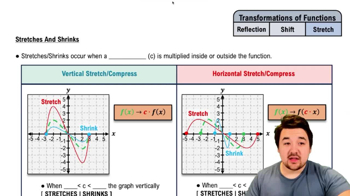
Identify the basic function and its characteristics. The given function is \(y = -2 \cos x\), which is a cosine function with an amplitude of 2 and a reflection about the x-axis due to the negative sign.
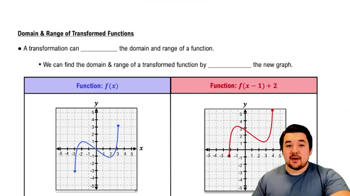
Recall the period of the cosine function. The standard cosine function \(\cos x\) has a period of \(2\pi\), so the function \(y = -2 \cos x\) will also have a period of \(2\pi\).
Determine the amplitude and vertical stretch. The amplitude is the absolute value of the coefficient in front of the cosine, which is \(| -2 | = 2\). This means the graph will oscillate between \(-2\) and \(2\), but reflected because of the negative sign.
Set the interval for one period. Since the period is \(2\pi\), choose the interval \([0, 2\pi]\) to graph one full cycle of the function.
Plot key points within the interval. At \(x=0\), \(y = -2 \cos 0 = -2 \times 1 = -2\). At \(x=\pi/2\), \(y = -2 \cos (\pi/2) = -2 \times 0 = 0\). At \(x=\pi\), \(y = -2 \cos \pi = -2 \times (-1) = 2\). At \(x=3\pi/2\), \(y = -2 \cos (3\pi/2) = -2 \times 0 = 0\). At \(x=2\pi\), \(y = -2 \cos (2\pi) = -2 \times 1 = -2\). Connect these points smoothly to complete the graph.
Verified video answer for a similar problem:
This video solution was recommended by our tutors as helpful for the problem above
Play a video:
0 Comments
Key Concepts
Here are the essential concepts you must grasp in order to answer the question correctly.
Period of the Cosine Function
The period of the basic cosine function y = cos x is 2π, meaning the function repeats its values every 2π units along the x-axis. When graphing over one period, you plot the function from 0 to 2π (or any interval of length 2π) to capture one full cycle.
The amplitude of a cosine function y = a cos x is the absolute value of a, representing the maximum distance from the midline to the peak. In y = -2 cos x, the amplitude is 2, and the negative sign reflects the graph across the x-axis, flipping the peaks and troughs.
Graphing Transformations of Trigonometric Functions
Graphing transformations include vertical shifts, stretches, and reflections. For y = -2 cos x, the negative sign causes a reflection over the x-axis, and the coefficient 2 stretches the graph vertically. Understanding these helps accurately sketch the function's shape and key points.

 Verified step by step guidance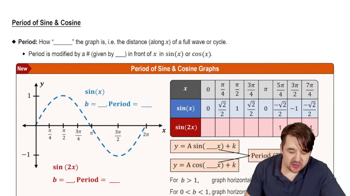
 5:33
5:33