2. Determine whether each number could represent the probability of an event. Explain your reasoning. b. 333.3%
Verified step by step guidance
1
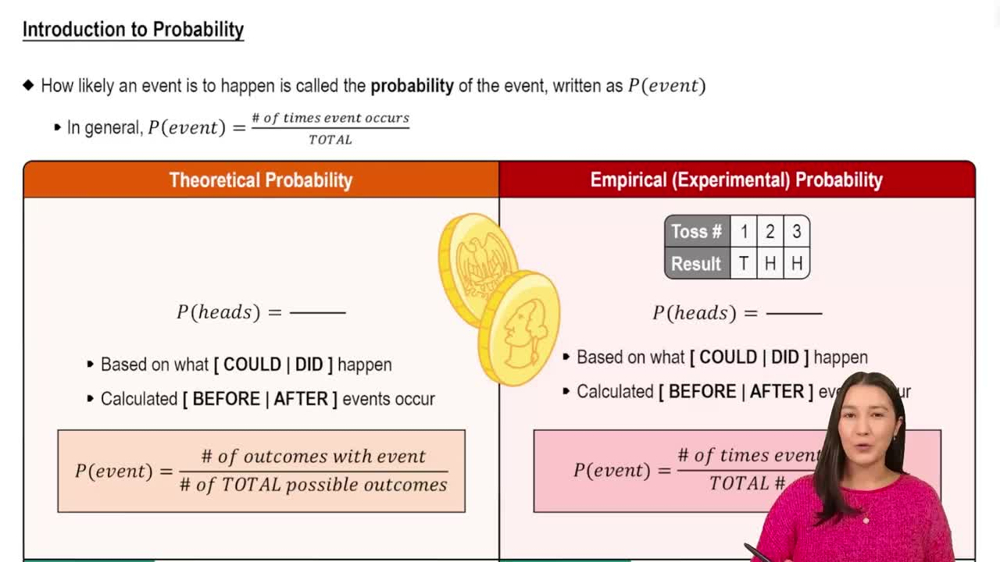
Step 1: Recall the definition of probability. Probability is a measure of the likelihood of an event occurring, and it is always expressed as a value between 0 and 1 (inclusive), where 0 represents an impossible event and 1 represents a certain event.
Step 2: Convert the given percentage (333.3%) into a decimal form by dividing it by 100. This gives 333.3% = 333.3 / 100 = 3.333.
Step 3: Compare the converted decimal value (3.333) to the valid range of probabilities, which is [0, 1]. If the value lies outside this range, it cannot represent a probability.
Step 4: Since 3.333 is greater than 1, it falls outside the valid range for probabilities. This means that 333.3% cannot represent the probability of an event.
Step 5: Conclude that probabilities must always be between 0% and 100% (or equivalently, 0 and 1 in decimal form). Any value outside this range is invalid as a probability.
Verified video answer for a similar problem:
This video solution was recommended by our tutors as helpful for the problem above
Video duration:
1m
Play a video:
0 Comments
Key Concepts
Here are the essential concepts you must grasp in order to answer the question correctly.
Probability Range
Probability is a measure of the likelihood of an event occurring, and it is always expressed as a value between 0 and 1, or as a percentage between 0% and 100%. A probability of 0 means the event will not occur, while a probability of 1 (or 100%) means it will certainly occur. Any value outside this range, such as 333.3%, is not a valid probability.
Percentages are a way to express a number as a fraction of 100. When discussing probabilities, percentages help to convey the likelihood of an event in a more intuitive manner. For example, a probability of 0.5 can be expressed as 50%. However, if a percentage exceeds 100%, it indicates an impossible scenario in the context of probability.
Understanding how to interpret probabilities is crucial in statistics. Probabilities should reflect the chance of an event occurring based on the total possible outcomes. If a probability is greater than 100%, it suggests that the event is more than certain, which is logically inconsistent and indicates a misunderstanding of probability principles.

 1:17 minutes
 Verified step by step guidance
 5:37
5:37