What did the Watson–Crick model suggest about the replication of DNA?
Verified step by step guidance
1
Recall that the Watson–Crick model of DNA describes the structure of DNA as a double helix composed of two complementary strands running in opposite directions.
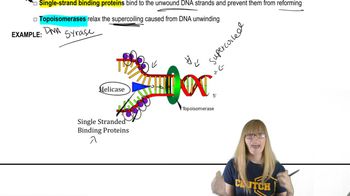
Understand that each strand of the DNA double helix serves as a template for the formation of a new complementary strand during replication.
Recognize that the base pairing rules (adenine pairs with thymine, and cytosine pairs with guanine) ensure that each new strand is an exact complement of the template strand.
Conclude that DNA replication is semiconservative, meaning that each new DNA molecule consists of one original (parental) strand and one newly synthesized strand.
Summarize that the Watson–Crick model suggested that the mechanism of DNA replication relies on the complementary base pairing and the separation of the two strands to produce two identical DNA molecules.
Verified video answer for a similar problem:
This video solution was recommended by our tutors as helpful for the problem above
Video duration:
1m
Play a video:
Was this helpful?
Key Concepts
Here are the essential concepts you must grasp in order to answer the question correctly.
Watson–Crick Model of DNA Structure
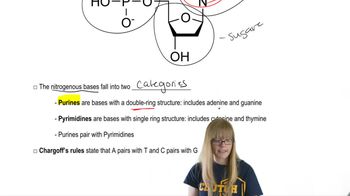
The Watson–Crick model describes DNA as a double helix composed of two complementary strands running in opposite directions. Each strand consists of a sugar-phosphate backbone with nitrogenous bases paired specifically (A with T, G with C) through hydrogen bonds, providing a stable yet flexible structure.
Complementary base pairing means that adenine (A) always pairs with thymine (T), and guanine (G) pairs with cytosine (C). This specificity allows each strand to serve as a template for creating a new complementary strand during DNA replication, ensuring accurate copying of genetic information.
The Watson–Crick model suggested that DNA replication is semi-conservative, meaning each new DNA molecule consists of one original (parental) strand and one newly synthesized strand. This mechanism preserves genetic information and allows cells to replicate DNA accurately before cell division.