Discuss how both gains and losses of regulatory elements may lead to human-specific traits.
Table of contents
- 1. Introduction to Genetics51m
- 2. Mendel's Laws of Inheritance3h 37m
- 3. Extensions to Mendelian Inheritance2h 41m
- 4. Genetic Mapping and Linkage2h 28m
- 5. Genetics of Bacteria and Viruses1h 21m
- 6. Chromosomal Variation1h 48m
- 7. DNA and Chromosome Structure56m
- 8. DNA Replication1h 10m
- 9. Mitosis and Meiosis1h 34m
- 10. Transcription1h 0m
- 11. Translation58m
- 12. Gene Regulation in Prokaryotes1h 19m
- 13. Gene Regulation in Eukaryotes44m
- 14. Genetic Control of Development44m
- 15. Genomes and Genomics1h 50m
- 16. Transposable Elements47m
- 17. Mutation, Repair, and Recombination1h 6m
- 18. Molecular Genetic Tools19m
- 19. Cancer Genetics29m
- 20. Quantitative Genetics1h 26m
- 21. Population Genetics50m
- 22. Evolutionary Genetics29m
22. Evolutionary Genetics
Phylogenetic Trees
Problem 7
Textbook Question
What must be assumed in order to validate the answers in Problem 7?
Verified step by step guidance1
Identify the context of Problem 7 to understand what genetic model or scenario it involves (e.g., Mendelian inheritance, population genetics, linkage analysis).
Determine the key assumptions typically required for the genetic model used in Problem 7, such as random mating, no mutation, no migration, large population size, or independent assortment.
Consider whether the problem assumes that alleles segregate according to Mendel's laws, which implies no gene interaction or linkage unless specified.
Check if the problem assumes that the traits are controlled by single genes with clear dominant and recessive alleles, or if more complex inheritance patterns are involved.
Summarize the assumptions needed to ensure that the calculations or predictions made in Problem 7 are valid, such as Hardy-Weinberg equilibrium conditions or absence of selection.
Verified video answer for a similar problem:This video solution was recommended by our tutors as helpful for the problem above
Video duration:
2mPlay a video:
Was this helpful?
Key Concepts
Here are the essential concepts you must grasp in order to answer the question correctly.
Assumptions in Genetic Models
Genetic problems often rely on specific assumptions, such as random mating, no mutation, or no selection, to simplify analysis. These assumptions ensure that the theoretical models apply and that the results are valid within the defined context.
Recommended video:
Guided course
Genetics of Development
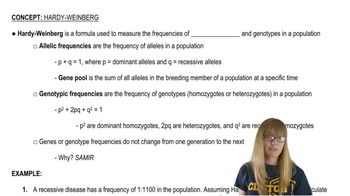
Hardy-Weinberg Equilibrium
This principle assumes a population is infinitely large, randomly mating, and not affected by mutation, migration, or selection. It provides a baseline to predict genotype frequencies from allele frequencies, which is often a key assumption in genetic problem-solving.
Recommended video:
Guided course
Hardy Weinberg
Model Limitations and Context
Understanding the limitations and context of a genetic problem is crucial. Assumptions must be explicitly stated to know when the model applies, as real populations may violate these assumptions, affecting the validity of the answers.
Recommended video:
Guided course
Sex-Linked Genes
Related Videos
Related Practice
Textbook Question
458
views