What was the significance of the polA1 mutation?
Table of contents
- 1. Introduction to Genetics51m
- 2. Mendel's Laws of Inheritance3h 37m
- 3. Extensions to Mendelian Inheritance2h 41m
- 4. Genetic Mapping and Linkage2h 28m
- 5. Genetics of Bacteria and Viruses1h 21m
- 6. Chromosomal Variation1h 48m
- 7. DNA and Chromosome Structure56m
- 8. DNA Replication1h 10m
- 9. Mitosis and Meiosis1h 34m
- 10. Transcription1h 0m
- 11. Translation58m
- 12. Gene Regulation in Prokaryotes1h 19m
- 13. Gene Regulation in Eukaryotes44m
- 14. Genetic Control of Development44m
- 15. Genomes and Genomics1h 50m
- 16. Transposable Elements47m
- 17. Mutation, Repair, and Recombination1h 6m
- 18. Molecular Genetic Tools19m
- 19. Cancer Genetics29m
- 20. Quantitative Genetics1h 26m
- 21. Population Genetics50m
- 22. Evolutionary Genetics29m
8. DNA Replication
Overview of DNA Replication
Problem 13
Textbook Question
List and describe the function of the ten subunits constituting DNA polymerase III. Distinguish between the holoenzyme and the core enzyme.
Verified step by step guidance1
Identify the ten subunits of DNA polymerase III, which include: α (alpha), ε (epsilon), θ (theta), β (beta), γ (gamma), δ (delta), δ' (delta prime), χ (chi), ψ (psi), and τ (tau).
Describe the function of each subunit: for example, α is the polymerase activity responsible for DNA synthesis; ε has 3' to 5' exonuclease proofreading activity; θ stabilizes ε; β forms the sliding clamp that increases processivity; γ complex acts as the clamp loader; δ and δ' are part of the clamp loader complex; χ and ψ help in clamp loader function and interaction with single-stranded DNA binding proteins; τ dimerizes the core polymerase and coordinates leading and lagging strand synthesis.
Explain that the core enzyme of DNA polymerase III consists of the α, ε, and θ subunits, which together carry out the polymerization and proofreading activities.
Define the holoenzyme as the complete DNA polymerase III complex, which includes the core enzyme plus the β sliding clamp and the clamp loader complex (γ, δ, δ', χ, ψ, and τ subunits), enabling high processivity and coordination of replication.
Summarize the distinction: the core enzyme performs the catalytic functions of DNA synthesis and proofreading, while the holoenzyme includes additional subunits that enhance processivity and coordinate the replication machinery.
Verified video answer for a similar problem:This video solution was recommended by our tutors as helpful for the problem above
Video duration:
2mPlay a video:
Was this helpful?
Key Concepts
Here are the essential concepts you must grasp in order to answer the question correctly.
Structure and Function of DNA Polymerase III Subunits
DNA polymerase III is a multi-subunit enzyme complex responsible for bacterial DNA replication. It consists of ten subunits, each with specific roles such as polymerization, proofreading, clamp loading, and processivity. Understanding these subunits helps explain how the enzyme efficiently synthesizes DNA with high fidelity.
Recommended video:
Guided course
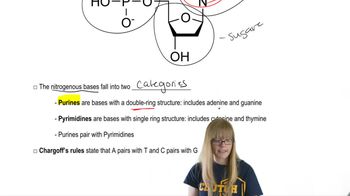
DNA Structure
Holoenzyme vs. Core Enzyme
The holoenzyme refers to the complete DNA polymerase III complex, including all subunits necessary for full activity, such as the clamp loader and sliding clamp. The core enzyme is a subset containing only the essential subunits for polymerization and proofreading. Distinguishing these clarifies the enzyme's functional modularity.
Recommended video:
Guided course
Traditional vs. Next-Gen
Role of the Sliding Clamp and Clamp Loader
The sliding clamp (β subunit) encircles DNA, increasing the polymerase's processivity by tethering it to the template. The clamp loader complex assembles the sliding clamp onto DNA. These components are crucial for rapid and continuous DNA synthesis during replication.
Recommended video:
Related Videos
Related Practice
Textbook Question
867
views