DNA polymerase III is the main DNA-synthesizing enzyme in bacteria. Describe how it carries out its role of elongating a strand of DNA.
Table of contents
- 1. Introduction to Genetics51m
- 2. Mendel's Laws of Inheritance3h 37m
- 3. Extensions to Mendelian Inheritance2h 41m
- 4. Genetic Mapping and Linkage2h 28m
- 5. Genetics of Bacteria and Viruses1h 21m
- 6. Chromosomal Variation1h 48m
- 7. DNA and Chromosome Structure56m
- 8. DNA Replication1h 10m
- 9. Mitosis and Meiosis1h 34m
- 10. Transcription1h 0m
- 11. Translation58m
- 12. Gene Regulation in Prokaryotes1h 19m
- 13. Gene Regulation in Eukaryotes44m
- 14. Genetic Control of Development44m
- 15. Genomes and Genomics1h 50m
- 16. Transposable Elements47m
- 17. Mutation, Repair, and Recombination1h 6m
- 18. Molecular Genetic Tools19m
- 19. Cancer Genetics29m
- 20. Quantitative Genetics1h 26m
- 21. Population Genetics50m
- 22. Evolutionary Genetics29m
8. DNA Replication
Overview of DNA Replication
Problem 12
Textbook Question
Summarize and compare the properties of DNA polymerase I, II, and III.
Verified step by step guidance1
Start by identifying the primary function of each DNA polymerase enzyme in prokaryotes, focusing on DNA polymerase I, II, and III.
Describe DNA polymerase I, emphasizing its role in removing RNA primers through its 5' to 3' exonuclease activity and filling in the resulting gaps with DNA.
Explain DNA polymerase II, noting its function mainly in DNA repair and its 3' to 5' exonuclease proofreading activity to maintain DNA fidelity.
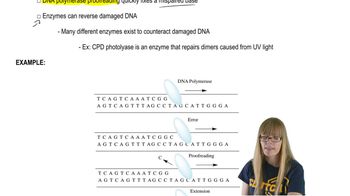
Detail DNA polymerase III as the main enzyme responsible for the bulk of DNA synthesis during replication, highlighting its high processivity and 3' to 5' exonuclease proofreading activity.
Compare the enzymes by summarizing their exonuclease activities, roles in replication versus repair, and their relative importance in the DNA replication process.
Verified video answer for a similar problem:This video solution was recommended by our tutors as helpful for the problem above
Video duration:
1mPlay a video:
Was this helpful?
Key Concepts
Here are the essential concepts you must grasp in order to answer the question correctly.
DNA Polymerase I
DNA Polymerase I is primarily involved in DNA repair and the removal of RNA primers during replication. It has 5' to 3' polymerase activity, 3' to 5' exonuclease proofreading, and unique 5' to 3' exonuclease activity that removes RNA primers, allowing replacement with DNA.
Recommended video:
Guided course
DNA Proofreading
DNA Polymerase II
DNA Polymerase II functions mainly in DNA repair and replication restart after damage. It possesses 5' to 3' polymerase and 3' to 5' exonuclease proofreading activities but lacks 5' to 3' exonuclease activity, making it less involved in primer removal.
Recommended video:
Guided course
DNA Proofreading
DNA Polymerase III
DNA Polymerase III is the primary enzyme responsible for bacterial DNA replication. It has high processivity and 5' to 3' polymerase activity, along with 3' to 5' exonuclease proofreading, but lacks 5' to 3' exonuclease activity, so it cannot remove RNA primers.
Recommended video:
Guided course
DNA Proofreading
Related Videos
Related Practice
Textbook Question
496
views