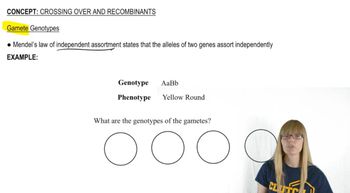
The term 'genotype' refers to the genetic makeup of an organism, specifically the set of alleles present at one or more loci on homologous chromosomes.
To understand genotype, it is important to know that alleles are different versions of a gene that can exist at a specific locus.
The genotype can be represented using symbols, such as 'AA', 'Aa', or 'aa', where each letter represents an allele inherited from one parent.
Genotype determines the potential traits an organism can express, but the actual expression of these traits depends on the interaction between the genotype and environmental factors.
For example, in Mendelian genetics, the genotype 'Aa' for a gene might result in a dominant phenotype due to the presence of one dominant allele (A) and one recessive allele (a).
Verified video answer for a similar problem:
This video solution was recommended by our tutors as helpful for the problem above
Video duration:
1m
Play a video:
Was this helpful?
Key Concepts
Here are the essential concepts you must grasp in order to answer the question correctly.
Genotype
The genotype refers to the genetic constitution of an organism, encompassing all the alleles inherited from its parents. It determines the potential traits that an organism can express, although not all genotypes are phenotypically visible. For example, an individual may carry alleles for a trait that are not expressed due to dominance or environmental factors.
Alleles are different versions of a gene that can exist at a specific locus on a chromosome. Each individual inherits two alleles for each gene, one from each parent, which can be identical (homozygous) or different (heterozygous). The combination of these alleles contributes to the organism's genotype and can influence its phenotype.
The phenotype is the observable physical or biochemical characteristics of an organism, determined by both its genotype and environmental influences. While the genotype provides the genetic blueprint, the phenotype reflects how these genes are expressed in the organism's traits, such as height, color, or behavior. Understanding the relationship between genotype and phenotype is crucial in genetics.