Describe the role of ¹⁵N in the Meselson–Stahl experiment.
Table of contents
- 1. Introduction to Genetics51m
- 2. Mendel's Laws of Inheritance3h 37m
- 3. Extensions to Mendelian Inheritance2h 41m
- 4. Genetic Mapping and Linkage2h 28m
- 5. Genetics of Bacteria and Viruses1h 21m
- 6. Chromosomal Variation1h 48m
- 7. DNA and Chromosome Structure56m
- 8. DNA Replication1h 10m
- 9. Mitosis and Meiosis1h 34m
- 10. Transcription1h 0m
- 11. Translation58m
- 12. Gene Regulation in Prokaryotes1h 19m
- 13. Gene Regulation in Eukaryotes44m
- 14. Genetic Control of Development44m
- 15. Genomes and Genomics1h 50m
- 16. Transposable Elements47m
- 17. Mutation, Repair, and Recombination1h 6m
- 18. Molecular Genetic Tools19m
- 19. Cancer Genetics29m
- 20. Quantitative Genetics1h 26m
- 21. Population Genetics50m
- 22. Evolutionary Genetics29m
8. DNA Replication
Overview of DNA Replication
Problem 8
Textbook Question
How did Kornberg assess the fidelity of DNA polymerase I in copying a DNA template?
Verified step by step guidance1
Understand that fidelity in DNA polymerase refers to the enzyme's accuracy in incorporating the correct nucleotides complementary to the DNA template strand during DNA synthesis.
Recognize that Kornberg assessed fidelity by measuring the frequency of errors (mutations) introduced by DNA polymerase I when copying a known DNA template sequence.
Kornberg used an experimental setup where DNA polymerase I was allowed to synthesize a new DNA strand using a single-stranded DNA template and a supply of nucleotides, including radioactive or labeled nucleotides to track incorporation.
He then analyzed the newly synthesized DNA product to detect mismatches or errors, often by using genetic assays that could reveal mutations or by biochemical methods that detect incorrect base pairing.
By comparing the number of correct incorporations to the number of errors, Kornberg calculated the fidelity of DNA polymerase I, often expressed as the error rate or accuracy per nucleotide incorporated.
Verified video answer for a similar problem:This video solution was recommended by our tutors as helpful for the problem above
Video duration:
1mPlay a video:
Was this helpful?
Key Concepts
Here are the essential concepts you must grasp in order to answer the question correctly.
DNA Polymerase I Function
DNA Polymerase I is an enzyme responsible for synthesizing DNA by adding nucleotides complementary to a DNA template strand. It also has proofreading activity, which helps correct errors during DNA replication, ensuring accurate DNA copying.
Recommended video:
Guided course
Functional Genomics
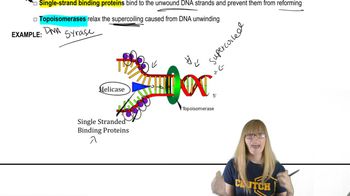
Fidelity of DNA Replication
Fidelity refers to the accuracy with which DNA polymerases replicate DNA. High fidelity means fewer errors or mutations during DNA synthesis, which is critical for maintaining genetic stability across generations.
Recommended video:
Guided course
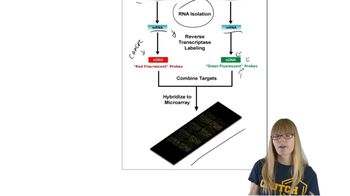
Steps to DNA Replication
Experimental Assessment of Enzyme Fidelity
Kornberg assessed DNA polymerase I fidelity by measuring the frequency of errors made during DNA synthesis, often using assays that detect mismatches or mutations in the newly synthesized DNA. This involved comparing the sequence of the product to the template to quantify accuracy.
Recommended video:
Guided course
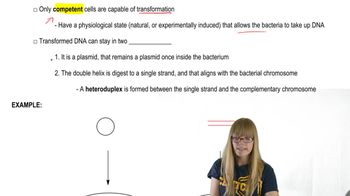
Transformation
Related Videos
Related Practice
Textbook Question
883
views