How can gene knockouts, transgenic animals, and gene editing techniques be used to explore gene function?
Table of contents
- 1. Introduction to Genetics51m
- 2. Mendel's Laws of Inheritance3h 37m
- 3. Extensions to Mendelian Inheritance2h 41m
- 4. Genetic Mapping and Linkage2h 28m
- 5. Genetics of Bacteria and Viruses1h 21m
- 6. Chromosomal Variation1h 48m
- 7. DNA and Chromosome Structure56m
- 8. DNA Replication1h 10m
- 9. Mitosis and Meiosis1h 34m
- 10. Transcription1h 0m
- 11. Translation58m
- 12. Gene Regulation in Prokaryotes1h 19m
- 13. Gene Regulation in Eukaryotes44m
- 14. Genetic Control of Development44m
- 15. Genomes and Genomics1h 50m
- 16. Transposable Elements47m
- 17. Mutation, Repair, and Recombination1h 6m
- 18. Molecular Genetic Tools19m
- 19. Cancer Genetics29m
- 20. Quantitative Genetics1h 26m
- 21. Population Genetics50m
- 22. Evolutionary Genetics29m
18. Molecular Genetic Tools
Genetic Cloning
Problem 1a
Textbook Question
In a recombinant DNA cloning experiment, how can we determine whether DNA fragments of interest have been incorporated into plasmids and, once host cells are transformed, which cells contain recombinant DNA?
Verified step by step guidance1
Understand that recombinant DNA cloning involves inserting DNA fragments of interest into plasmid vectors, which are then introduced into host cells (usually bacteria) through transformation.
To determine if DNA fragments have been incorporated into plasmids, use a screening method such as blue-white screening. This involves plasmids containing a reporter gene (like lacZ) that is disrupted when the DNA fragment is inserted, resulting in white colonies instead of blue on X-gal containing media.
Another method is to perform restriction enzyme digestion on isolated plasmids from transformed cells. By cutting the plasmid with specific enzymes and running the fragments on an agarose gel, you can compare the pattern to expected sizes to confirm the presence of the insert.
Once host cells are transformed, select for cells containing plasmids by growing them on antibiotic-containing media, since plasmids usually carry an antibiotic resistance gene. Only cells with plasmids will survive.
Finally, to identify which surviving cells contain recombinant DNA (plasmids with the insert), use colony PCR or plasmid isolation followed by sequencing or restriction analysis to verify the presence of the DNA fragment of interest.
Verified video answer for a similar problem:This video solution was recommended by our tutors as helpful for the problem above
Video duration:
2mPlay a video:
Was this helpful?
Key Concepts
Here are the essential concepts you must grasp in order to answer the question correctly.
Recombinant DNA Cloning
Recombinant DNA cloning involves inserting a DNA fragment of interest into a plasmid vector to create a recombinant molecule. This plasmid is then introduced into host cells, typically bacteria, to replicate and produce multiple copies of the inserted DNA. Understanding this process is essential to grasp how foreign DNA is propagated and analyzed.
Recommended video:
Guided course
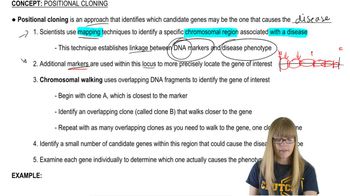
Positional Cloning
Selection and Screening Techniques
Selection uses antibiotic resistance genes in plasmids to identify host cells that have taken up plasmids, while screening distinguishes cells containing recombinant plasmids from those with non-recombinant plasmids. Common methods include blue-white screening, where disruption of a reporter gene indicates successful insertion, and colony PCR or restriction digestion for confirmation.
Recommended video:
Guided course
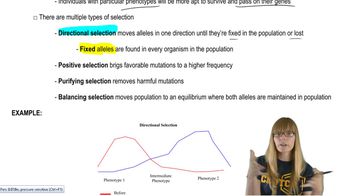
Natural Selection
Molecular Confirmation of Recombinant DNA
After transformation, molecular techniques such as restriction enzyme analysis, PCR amplification, or DNA sequencing are used to verify the presence and correct orientation of the inserted DNA fragment within plasmids. These methods ensure that the recombinant DNA is accurately constructed before further experiments.
Recommended video:
Guided course
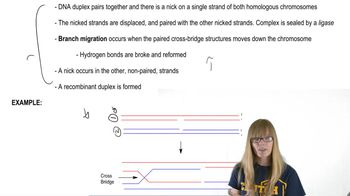
Recombination after Single Strand Breaks
Related Videos
Related Practice
Textbook Question
445
views