Summarize the steps involved in charging tRNAs with their appropriate amino acids.
Verified step by step guidance
1
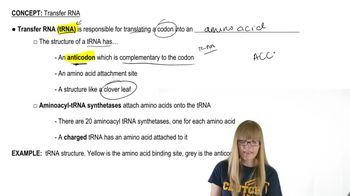
Identify the specific amino acid and its corresponding tRNA molecule, which has an anticodon complementary to the mRNA codon for that amino acid.
Recognize that the enzyme aminoacyl-tRNA synthetase catalyzes the attachment of the amino acid to its correct tRNA; each amino acid has its own specific synthetase.
Understand that the charging process begins with the activation of the amino acid by reacting it with ATP, forming an aminoacyl-AMP intermediate and releasing pyrophosphate (PPi). This can be represented as: \[\text{Amino acid} + \text{ATP} \rightarrow \text{Aminoacyl-AMP} + \text{PPi}\]
Next, the activated amino acid is transferred from aminoacyl-AMP to the 3' end of the tRNA, forming aminoacyl-tRNA and releasing AMP: \[\text{Aminoacyl-AMP} + \text{tRNA} \rightarrow \text{Aminoacyl-tRNA} + \text{AMP}\]
Finally, the charged tRNA (aminoacyl-tRNA) is released from the synthetase enzyme and is now ready to deliver its amino acid to the ribosome during protein synthesis.
Verified video answer for a similar problem:
This video solution was recommended by our tutors as helpful for the problem above
Video duration:
54s
Play a video:
Was this helpful?
Key Concepts
Here are the essential concepts you must grasp in order to answer the question correctly.
Role of tRNA in Protein Synthesis
Transfer RNA (tRNA) molecules serve as adaptors that translate the genetic code from mRNA into amino acids during protein synthesis. Each tRNA carries a specific amino acid and has an anticodon that pairs with the corresponding codon on the mRNA, ensuring correct amino acid incorporation.
Aminoacyl-tRNA synthetases are enzymes that catalyze the attachment of amino acids to their corresponding tRNAs. Each enzyme is specific to one amino acid and its compatible tRNAs, ensuring high fidelity in matching amino acids to the correct tRNA molecules.
Charging tRNA involves a two-step reaction: first, the amino acid is activated by ATP to form aminoacyl-AMP; second, the activated amino acid is transferred to the 3' end of the tRNA. This process forms aminoacyl-tRNA, which is then ready to participate in translation.