To carry out its role, each transfer RNA requires at least four specific recognition sites that must be inherent in its tertiary structure. What are they?
Verified step by step guidance
1
Understand that transfer RNA (tRNA) molecules have a specific three-dimensional (tertiary) structure essential for their function in translation.
Recall that tRNA must be recognized by several molecules during protein synthesis, which requires specific recognition sites on the tRNA.
Identify the four key recognition sites on tRNA: the amino acid attachment site (3' CCA end), the anticodon loop, the D loop, and the TΨC loop.
Explain the role of each site: the amino acid attachment site binds the correct amino acid; the anticodon loop pairs with the mRNA codon; the D loop and TΨC loop contribute to proper folding and recognition by aminoacyl-tRNA synthetases and ribosomes.
Summarize that these four sites are essential for the tRNA to be correctly charged with an amino acid and to interact properly with the ribosome and mRNA during translation.
Verified video answer for a similar problem:
This video solution was recommended by our tutors as helpful for the problem above
Video duration:
2m
Play a video:
Was this helpful?
Key Concepts
Here are the essential concepts you must grasp in order to answer the question correctly.
tRNA Structure and Function
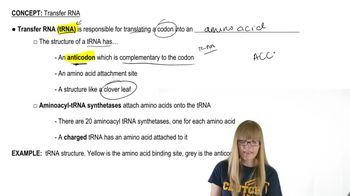
Transfer RNA (tRNA) is a small RNA molecule that delivers specific amino acids to the ribosome during protein synthesis. Its tertiary structure is a folded three-dimensional shape essential for its function, allowing it to interact accurately with aminoacyl-tRNA synthetases, ribosomes, and mRNA.
tRNA molecules have specific recognition sites that enable correct amino acid attachment and interaction with the translation machinery. These include the acceptor stem for amino acid attachment, the anticodon loop for mRNA codon recognition, and other structural features that ensure proper enzyme and ribosome binding.
Aminoacyl-tRNA synthetases are enzymes that charge tRNAs with their corresponding amino acids. They recognize tRNAs through multiple identity elements or recognition sites on the tRNA, ensuring high fidelity in protein synthesis by matching the correct amino acid to its tRNA.