What experimentally derived information led to Holley's proposal of the two-dimensional cloverleaf model of tRNA?
Verified step by step guidance
1
Understand that Holley aimed to determine the nucleotide sequence of a specific tRNA molecule to reveal its structure and function.
Recognize that Holley and his team used enzymatic digestion and chemical methods to break down the tRNA into smaller fragments, which were then sequenced to determine the order of nucleotides.
Note that by overlapping these sequenced fragments, Holley was able to deduce the complete linear sequence of the tRNA molecule.
Observe that the sequence data revealed regions of complementary base pairing within the tRNA, suggesting the molecule folds back on itself to form double-stranded stems and single-stranded loops.
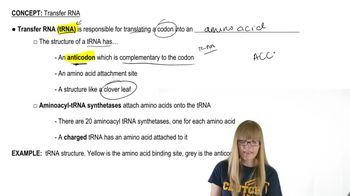
Conclude that this pattern of internal base pairing and loops led Holley to propose the two-dimensional cloverleaf model, where the tRNA has a characteristic secondary structure with distinct arms and loops.
Verified video answer for a similar problem:
This video solution was recommended by our tutors as helpful for the problem above
Video duration:
1m
Play a video:
Was this helpful?
Key Concepts
Here are the essential concepts you must grasp in order to answer the question correctly.
tRNA Structure and Function
Transfer RNA (tRNA) is a small RNA molecule that helps decode messenger RNA (mRNA) sequences into proteins by carrying specific amino acids to the ribosome during translation. Understanding its structure is crucial because it must interact with both mRNA and amino acids accurately.
Determining the exact sequence of nucleotides in tRNA allowed researchers to identify regions of complementary bases that could form intramolecular hydrogen bonds. This base pairing suggested a folded, two-dimensional structure rather than a simple linear chain.
Holley's Experimental Evidence and the Cloverleaf Model
Holley used enzymatic digestion and chemical sequencing to map the nucleotide sequence of yeast alanine tRNA, revealing specific base-paired stems and loops. This data led him to propose the cloverleaf secondary structure, showing how tRNA folds into a stable shape essential for its function.