Which of the following represent trait variation caused from genetic variation?
Table of contents
- 1. Introduction to Genetics51m
- 2. Mendel's Laws of Inheritance3h 37m
- 3. Extensions to Mendelian Inheritance2h 41m
- 4. Genetic Mapping and Linkage2h 28m
- 5. Genetics of Bacteria and Viruses1h 21m
- 6. Chromosomal Variation1h 48m
- 7. DNA and Chromosome Structure56m
- 8. DNA Replication1h 10m
- 9. Mitosis and Meiosis1h 34m
- 10. Transcription1h 0m
- 11. Translation58m
- 12. Gene Regulation in Prokaryotes1h 19m
- 13. Gene Regulation in Eukaryotes44m
- 14. Genetic Control of Development44m
- 15. Genomes and Genomics1h 50m
- 16. Transposable Elements47m
- 17. Mutation, Repair, and Recombination1h 6m
- 18. Molecular Genetic Tools19m
- 19. Cancer Genetics29m
- 20. Quantitative Genetics1h 26m
- 21. Population Genetics50m
- 22. Evolutionary Genetics29m
20. Quantitative Genetics
Analyzing Trait Variance
Problem 4d
Textbook Question
A dark-red strain and a white strain of wheat are crossed and produce an intermediate, medium-red F₁. When the F₁ plants are interbred, an F₂ generation is produced in a ratio of 1 dark-red: 4 medium-dark-red: 6 medium-red: 4 light-red: 1 white. Further crosses reveal that the dark-red and white F₂ plants are true breeding
Predict the outcome of the F1 and F2 generations in a cross between a true-breeding medium-red plant and a white plant.
Verified step by step guidance1
Step 1: Understand the inheritance pattern described. The F₁ generation shows an intermediate phenotype (medium-red) from crossing dark-red and white strains, and the F₂ generation shows a 1:4:6:4:1 phenotypic ratio. This ratio suggests incomplete dominance involving two genes or alleles contributing additively to the color intensity.
Step 2: Identify the genotypes corresponding to each phenotype in the F₂ generation. Since dark-red and white are true breeding, assign genotypes such as DD for dark-red and dd for white, with intermediate phenotypes representing heterozygous combinations (e.g., Dd). The 1:4:6:4:1 ratio resembles a binomial expansion, indicating two loci or alleles with additive effects.
Step 3: Determine the genotype of the true-breeding medium-red plant. Since medium-red is intermediate but true breeding, it likely corresponds to a homozygous genotype different from dark-red and white, for example, a heterozygous combination at two loci or a specific homozygous genotype at one locus.
Step 4: Set up the cross between the true-breeding medium-red plant and the white plant. Write down the genotypes of both parents based on the previous step, then use a Punnett square or combinatorial approach to predict the genotypes and phenotypes of the F₁ offspring.
Step 5: Predict the F₂ generation by interbreeding the F₁ plants from the cross in Step 4. Use the genotypes obtained to calculate the expected phenotypic ratios, considering the additive effects of alleles and incomplete dominance, similar to the original F₂ ratio but adjusted for the new parental genotypes.
Verified video answer for a similar problem:This video solution was recommended by our tutors as helpful for the problem above
Video duration:
1mPlay a video:
Was this helpful?
Key Concepts
Here are the essential concepts you must grasp in order to answer the question correctly.
Incomplete Dominance
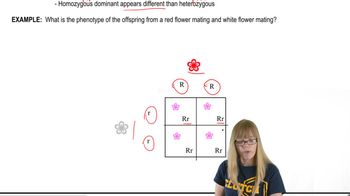
Incomplete dominance occurs when the heterozygote phenotype is intermediate between the two homozygotes, rather than one allele being completely dominant. In this wheat example, crossing dark-red and white strains produces a medium-red F₁, showing blending of traits rather than classic dominant-recessive inheritance.
Recommended video:
Guided course
Variations on Dominance
Multiple Alleles and Polygenic Inheritance
The F₂ ratio with five phenotypic classes suggests more than two alleles or multiple genes influence color intensity. Polygenic inheritance involves several genes contributing additively to a trait, producing a range of phenotypes, as seen in the gradation from white to dark-red wheat.
Recommended video:
Guided course
New Alleles and Migration
True Breeding and Genotype-Phenotype Relationship
True-breeding plants are homozygous for their traits, consistently producing offspring with the same phenotype. Knowing that dark-red and white F₂ plants are true breeding helps infer genotypes and predict outcomes of crosses, such as between medium-red and white plants.
Recommended video:
Guided course
Epistatic Genes
Watch next
Master Analyzing Trait Variance with a bite sized video explanation from Kylia
Start learningRelated Videos
Related Practice
Multiple Choice
413
views
1
rank
1
comments
