Wild-type E. coli grows best at 37°C but can grow efficiently up to 42°C. An E. coli strain has a mutation of the sigma subunit that results in an RNA polymerase holoenzyme that is stable and transcribes at wild-type levels at 37°C. The mutant holoenzyme is progressively destabilized as the temperature is raised, and it completely denatures and ceases to carry out transcription at 42°C. Relative to wild-type growth, characterize the ability of the mutant strain to carry out transcription at What term best characterizes the type of mutation exhibited by the mutant bacterial strain? (Hint: The term was used in Chapter 4 to describe the Himalayan allele of the mammalian C gene.)
Table of contents
- 1. Introduction to Genetics51m
- 2. Mendel's Laws of Inheritance3h 37m
- 3. Extensions to Mendelian Inheritance2h 41m
- 4. Genetic Mapping and Linkage2h 28m
- 5. Genetics of Bacteria and Viruses1h 21m
- 6. Chromosomal Variation1h 48m
- 7. DNA and Chromosome Structure56m
- 8. DNA Replication1h 10m
- 9. Mitosis and Meiosis1h 34m
- 10. Transcription1h 0m
- 11. Translation58m
- 12. Gene Regulation in Prokaryotes1h 19m
- 13. Gene Regulation in Eukaryotes44m
- 14. Genetic Control of Development44m
- 15. Genomes and Genomics1h 50m
- 16. Transposable Elements47m
- 17. Mutation, Repair, and Recombination1h 6m
- 18. Molecular Genetic Tools19m
- 19. Cancer Genetics29m
- 20. Quantitative Genetics1h 26m
- 21. Population Genetics50m
- 22. Evolutionary Genetics29m
10. Transcription
Transcription in Prokaryotes
Problem 20
Textbook Question
Write a paragraph describing the abbreviated chemical reactions that summarize RNA polymerase-directed transcription.
Verified step by step guidance1
Begin by explaining that RNA polymerase-directed transcription is the process by which RNA polymerase synthesizes RNA from a DNA template strand.
Describe the initiation step where RNA polymerase binds to the promoter region of DNA, causing the DNA strands to unwind and expose the template strand.
Explain the elongation step, where RNA polymerase moves along the DNA template strand, adding ribonucleotides complementary to the DNA template, forming an RNA strand. This can be summarized by the reaction: \(\text{(DNA template)} + \text{rNTPs} \rightarrow \text{RNA} + \text{PPi}\), where rNTPs are ribonucleoside triphosphates and PPi is pyrophosphate.
Mention that the RNA strand grows in the 5' to 3' direction, with RNA polymerase catalyzing the formation of phosphodiester bonds between nucleotides.
Conclude with the termination step, where RNA polymerase reaches a termination signal on the DNA, causing the release of the newly synthesized RNA transcript and dissociation of RNA polymerase from the DNA.
Verified video answer for a similar problem:This video solution was recommended by our tutors as helpful for the problem above
Video duration:
3mPlay a video:
Was this helpful?
Key Concepts
Here are the essential concepts you must grasp in order to answer the question correctly.
RNA Polymerase Function
RNA polymerase is the enzyme responsible for synthesizing RNA from a DNA template during transcription. It binds to the promoter region, unwinds the DNA, and catalyzes the formation of phosphodiester bonds between ribonucleotides, creating a complementary RNA strand.
Recommended video:
Transcription Process and Directionality
Transcription proceeds in the 5' to 3' direction, where RNA polymerase reads the DNA template strand in the 3' to 5' direction. Ribonucleoside triphosphates (NTPs) are added sequentially, releasing pyrophosphate and forming the growing RNA chain.
Recommended video:
Guided course
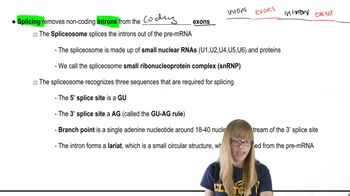
mRNA Processing
Chemical Reaction of Nucleotide Addition
The core chemical reaction involves the nucleophilic attack of the 3'-OH group of the growing RNA chain on the α-phosphate of an incoming NTP. This reaction forms a phosphodiester bond and releases pyrophosphate (PPi), which is subsequently hydrolyzed to drive the reaction forward.
Recommended video:
Guided course
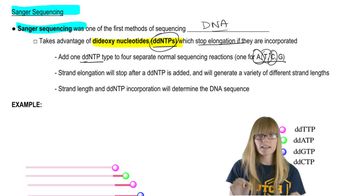
Sanger Sequencing
Watch next
Master Prokaryotic Transcription with a bite sized video explanation from Kylia
Start learningRelated Videos
Related Practice
Textbook Question
569
views