With respect to transcription describe the relationship and sequence correspondence of the RNA transcript and the DNA template strand. Describe the relationship and sequence correspondence of the mRNA transcript to the DNA coding strand.
Verified step by step guidance
1
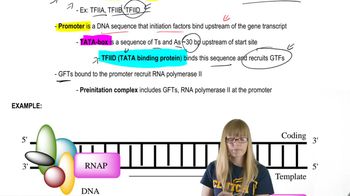
Understand that transcription is the process by which RNA is synthesized from a DNA template. The RNA transcript is complementary to the DNA template strand and is synthesized in the 5' to 3' direction.
The DNA template strand is also referred to as the antisense strand. The RNA transcript is complementary to this strand, meaning that for every adenine (A) in the DNA template, uracil (U) is incorporated into the RNA, and for every thymine (T) in the DNA template, adenine (A) is incorporated into the RNA. Cytosine (C) pairs with guanine (G), and guanine (G) pairs with cytosine (C).
The DNA coding strand, also known as the sense strand, has the same sequence as the RNA transcript, except that thymine (T) in the DNA is replaced by uracil (U) in the RNA. This is because the coding strand is not used as the template during transcription.
The RNA transcript is synthesized by RNA polymerase, which reads the DNA template strand in the 3' to 5' direction and synthesizes the RNA in the 5' to 3' direction. This ensures that the RNA transcript is complementary to the template strand and matches the coding strand (with U replacing T).
In summary, the RNA transcript is complementary to the DNA template strand and has the same sequence as the DNA coding strand (with U replacing T). This sequence correspondence is critical for ensuring that the genetic information is accurately transcribed into RNA for subsequent translation into proteins.
Verified video answer for a similar problem:
This video solution was recommended by our tutors as helpful for the problem above
Video duration:
2m
Play a video:
Was this helpful?
Key Concepts
Here are the essential concepts you must grasp in order to answer the question correctly.
Transcription
Transcription is the process by which the genetic information encoded in DNA is copied into messenger RNA (mRNA). During transcription, RNA polymerase binds to the DNA template strand and synthesizes a complementary RNA strand. This process occurs in the nucleus of eukaryotic cells and is essential for gene expression, as it converts the genetic code into a format that can be translated into proteins.
The DNA template strand is the strand of DNA that is used as a guide for synthesizing RNA during transcription. It is complementary to the RNA transcript, meaning that RNA nucleotides pair with their corresponding DNA bases (A with U, T with A, C with G, and G with C). The DNA coding strand, on the other hand, has the same sequence as the mRNA transcript (except for the substitution of uracil for thymine) and is not used directly in the transcription process.
Sequence correspondence refers to the relationship between the nucleotide sequences of the DNA strands and the resulting RNA transcript. The RNA transcript is synthesized based on the sequence of the DNA template strand, ensuring that the order of nucleotides in the mRNA reflects the complementary sequence of the template. This correspondence is crucial for accurate protein synthesis, as it determines the sequence of amino acids in the resulting polypeptide chain.