Identify which of the following lac operon haploid genotypes transcribe operon genes inducibly and which transcribe genes constitutively. Indicate whether the strain is lac⁺ (able to grow on lactose-only medium) or lac⁻ (cannot grow on lactose medium). I⁺ P⁻ O⁺ Z⁺ Y⁺
Verified step by step guidance
1
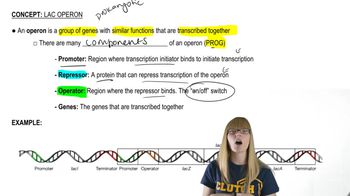
Understand the components of the lac operon: The lac operon consists of the regulatory gene (I), the promoter (P), the operator (O), and the structural genes (Z and Y). The I gene encodes the repressor protein, P is the binding site for RNA polymerase, O is the binding site for the repressor, Z encodes β-galactosidase, and Y encodes permease.
Analyze the given genotype: I⁺ P⁻ O⁺ Z⁺ Y⁺. Here, I⁺ indicates a functional repressor protein, P⁻ indicates a defective promoter, O⁺ indicates a functional operator, Z⁺ indicates a functional β-galactosidase gene, and Y⁺ indicates a functional permease gene.
Determine the impact of the P⁻ mutation: A defective promoter (P⁻) prevents RNA polymerase from binding to the DNA, which means transcription of the operon genes (Z and Y) cannot occur, regardless of the presence or absence of lactose.
Assess whether the strain is inducible or constitutive: Since the promoter is defective, the operon cannot be transcribed under any conditions. Therefore, the operon is neither inducible nor constitutive.
Evaluate the strain's ability to grow on lactose-only medium: Because the operon cannot be transcribed, the enzymes β-galactosidase and permease are not produced. Without these enzymes, the strain cannot metabolize lactose, making it lac⁻ (unable to grow on lactose-only medium).
Verified video answer for a similar problem:
This video solution was recommended by our tutors as helpful for the problem above
Video duration:
3m
Play a video:
Was this helpful?
Key Concepts
Here are the essential concepts you must grasp in order to answer the question correctly.
Lac Operon Structure
The lac operon is a set of genes in E. coli that are involved in the metabolism of lactose. It consists of structural genes (Z, Y, A) that code for enzymes needed to break down lactose, along with regulatory elements such as the promoter (P) and operator (O). Understanding the arrangement and function of these components is crucial for determining how the operon responds to lactose presence.
Inducible expression refers to genes that are turned on in response to specific signals, such as the presence of lactose in the case of the lac operon. In contrast, constitutive expression occurs when genes are continuously expressed regardless of environmental conditions. Recognizing these patterns is essential for analyzing how different genotypes affect the operon's activity.
Haploid genotypes contain a single set of chromosomes, which means that any mutation or alteration in a gene will directly affect the phenotype. In the context of the lac operon, specific mutations in the regulatory regions (I, P, O) can lead to either inducible or constitutive expression of the operon genes, influencing whether the strain can utilize lactose as a carbon source.