Answer the following questions concerning the accuracy of DNA polymerase during replication. What general mechanism do DNA polymerases use to check the accuracy of DNA replication and identify errors during replication?
Verified step by step guidance
1
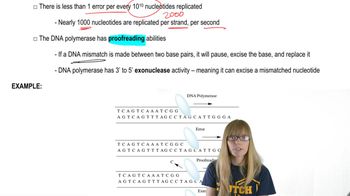
DNA polymerases use a mechanism called 'proofreading' to ensure the accuracy of DNA replication. This involves the enzyme checking each newly added nucleotide against the template strand to confirm correct base pairing.
If an incorrect nucleotide is incorporated, the DNA polymerase detects the mismatch due to improper hydrogen bonding between the bases.
The enzyme pauses and activates its 3' to 5' exonuclease activity, which removes the incorrectly paired nucleotide from the growing DNA strand.
After the incorrect nucleotide is removed, the DNA polymerase resumes synthesis by adding the correct nucleotide to the strand.
This proofreading mechanism significantly reduces the error rate during DNA replication, ensuring high fidelity in the process.
Verified video answer for a similar problem:
This video solution was recommended by our tutors as helpful for the problem above
Video duration:
1m
Play a video:
Was this helpful?
Key Concepts
Here are the essential concepts you must grasp in order to answer the question correctly.
DNA Polymerase Function
DNA polymerases are enzymes responsible for synthesizing new DNA strands by adding nucleotides complementary to the template strand. They play a crucial role in DNA replication, ensuring that the genetic information is accurately copied. Their activity is essential for cell division and the maintenance of genetic integrity.
DNA polymerases possess a proofreading ability that allows them to identify and correct errors during DNA replication. This mechanism involves a 3' to 5' exonuclease activity, which removes incorrectly paired nucleotides. By excising these errors, DNA polymerases enhance the fidelity of DNA synthesis, reducing the mutation rate.
In addition to the proofreading function of DNA polymerases, cells have a mismatch repair system that further ensures replication accuracy. This system detects and repairs mismatched base pairs that escape the proofreading process. It involves a series of proteins that recognize the error, excise the incorrect segment, and fill in the correct nucleotides, thus maintaining genomic stability.