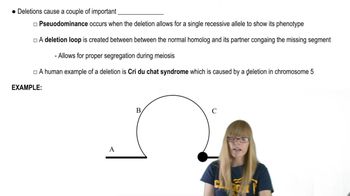
A healthy couple with a history of three previous spontaneous abortions has just had a child with cri-du-chat syndrome, a disorder caused by a terminal deletion of chromosome 5. Their physician orders karyotype analysis of both parents and of the child. The karyotype results for chromosomes 5 and 12 are shown here. What segregation pattern occurred to produce the gamete involved in fertilization of the child with cri-du-chat syndrome?
Verified step by step guidance
1
Understand the genetic basis of cri-du-chat syndrome: This syndrome is caused by a terminal deletion on the short arm of chromosome 5 (5p). This deletion results in the loss of genetic material, leading to the characteristic symptoms of the disorder.
Analyze the karyotype results: Carefully examine the karyotype data provided for chromosomes 5 and 12 in the parents and the child. Look for any structural abnormalities, such as translocations, deletions, or duplications, in the parental chromosomes that could explain the origin of the deletion in the child.
Determine if a balanced translocation is present in one of the parents: A balanced translocation occurs when two chromosomes exchange segments without any loss or gain of genetic material. If one parent carries a balanced translocation involving chromosome 5, this could lead to an unbalanced gamete during meiosis, resulting in the deletion observed in the child.
Identify the segregation pattern during meiosis: If a parent has a balanced translocation, consider the possible segregation patterns during meiosis. Specifically, focus on adjacent-1 segregation, which can produce gametes with unbalanced chromosomal content. This could lead to the terminal deletion on chromosome 5 in the child.
Conclude the segregation pattern: Based on the karyotype analysis and the presence of a balanced translocation in one parent, the most likely segregation pattern is adjacent-1 segregation. This pattern would result in the gamete carrying the unbalanced chromosomal content (the terminal deletion on chromosome 5) that contributed to the child’s cri-du-chat syndrome.
Verified video answer for a similar problem:
This video solution was recommended by our tutors as helpful for the problem above
Video duration:
2m
Play a video:
Was this helpful?
Key Concepts
Here are the essential concepts you must grasp in order to answer the question correctly.
Chromosomal Deletion
Chromosomal deletion refers to the loss of a segment of a chromosome, which can lead to genetic disorders. In the case of cri-du-chat syndrome, a terminal deletion of chromosome 5 results in the loss of critical genes, leading to the characteristic symptoms of the disorder. Understanding this concept is essential for analyzing how such deletions can occur and their implications for offspring.
Karyotype analysis is a laboratory technique used to visualize an individual's chromosomes, allowing for the identification of chromosomal abnormalities such as deletions, duplications, or aneuploidies. This analysis is crucial in diagnosing genetic disorders and understanding the genetic makeup of individuals, particularly in cases of suspected chromosomal syndromes like cri-du-chat.
Segregation patterns refer to the distribution of alleles during gamete formation, as described by Mendel's laws of inheritance. In the context of this question, understanding how chromosomes segregate during meiosis can help explain how a gamete with a deletion on chromosome 5 could lead to the fertilization event resulting in cri-du-chat syndrome. This concept is fundamental for grasping the genetic mechanisms behind inherited disorders.