Join thousands of students who trust us to help them ace their exams!
Multiple Choice
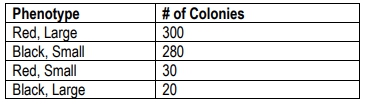
A mixed infection of two bacteriophage strains was performed. Infection of bacteriophage strain 1 causes the bacteria to be red and large, while infection of bacteriophage strain 2 causes the bacteria colony to be black and small. The following results were obtained. Using this data, determine the distance between the color and size genes.
A
45.3 m.u
B
15.7 m.u
C
7.9 m.u
D
2.2 m.u
0 Comments
Verified step by step guidance
1
Identify the parental and recombinant phenotypes. The parental phenotypes are Red, Large and Black, Small, as they are the most frequent. The recombinant phenotypes are Red, Small and Black, Large, as they are less frequent.
Calculate the total number of colonies by adding all the colonies: 300 (Red, Large) + 280 (Black, Small) + 30 (Red, Small) + 20 (Black, Large).
Determine the number of recombinant colonies by adding the numbers of the recombinant phenotypes: 30 (Red, Small) + 20 (Black, Large).
Calculate the recombination frequency by dividing the number of recombinant colonies by the total number of colonies, then multiply by 100 to convert it to a percentage.
The recombination frequency, expressed as a percentage, is equivalent to the map units (m.u) between the genes. This value will help you determine the genetic distance between the color and size genes.


 Verified step by step guidance

