A recent study examining the mutation rates of 5669 mammalian genes (17,208 sequences) indicates that, contrary to popular belief, mutation rates among lineages with vastly different generation lengths and physiological attributes are remarkably constant [Kumar, S., and Subramanian, S. (2002). Proc. Natl. Acad. Sci. USA 99:803–808]. The average rate is estimated at 12.2×10⁻⁹ per bp per year. What is the significance of this finding in terms of mammalian evolution?
Table of contents
- 1. Introduction to Genetics51m
- 2. Mendel's Laws of Inheritance3h 37m
- 3. Extensions to Mendelian Inheritance2h 41m
- 4. Genetic Mapping and Linkage2h 28m
- 5. Genetics of Bacteria and Viruses1h 21m
- 6. Chromosomal Variation1h 48m
- 7. DNA and Chromosome Structure56m
- 8. DNA Replication1h 10m
- 9. Mitosis and Meiosis1h 34m
- 10. Transcription1h 0m
- 11. Translation58m
- 12. Gene Regulation in Prokaryotes1h 19m
- 13. Gene Regulation in Eukaryotes44m
- 14. Genetic Control of Development44m
- 15. Genomes and Genomics1h 50m
- 16. Transposable Elements47m
- 17. Mutation, Repair, and Recombination1h 6m
- 18. Molecular Genetic Tools19m
- 19. Cancer Genetics29m
- 20. Quantitative Genetics1h 26m
- 21. Population Genetics50m
- 22. Evolutionary Genetics29m
21. Population Genetics
Allelic Frequency Changes
Problem 21
Textbook Question
In an isolated population of 50 desert bighorn sheep, a mutant recessive allele c when homozygous causes curled coats in both males and females. The normal dominant allele C produces straight coats. A biologist studying these sheep counts four with curled coats. She also takes blood samples from the population for DNA analysis, which reveals that 17 of the sheep are heterozygous carriers of the c allele. What is the inbreeding coefficient F for this population?
Verified step by step guidance1
Identify the given information: total population size (N = 50), number of individuals with the recessive phenotype (curled coats, which are homozygous recessive cc = 4), and number of heterozygous carriers (Cc = 17).
Calculate the observed frequency of the recessive homozygous genotype (cc) in the population: \(\hat{q^2} = \frac{\text{number of cc individuals}}{N} = \frac{4}{50}\).
Calculate the observed frequency of the heterozygous genotype (Cc) in the population: \(\hat{2pq} = \frac{17}{50}\).
Estimate the allele frequencies under Hardy-Weinberg equilibrium: the frequency of the recessive allele \(q\) can be estimated as \(q = \sqrt{\hat{q^2}}\), and the dominant allele frequency \(p = 1 - q\).
Use the formula for the inbreeding coefficient \(F\), which measures the reduction in heterozygosity compared to Hardy-Weinberg expectations:
\(F = \frac{(2pq)_{expected} - (2pq)_{observed}}{(2pq)_{expected}}\),
where \((2pq)_{expected} = 2pq\) calculated from allele frequencies assuming random mating, and \((2pq)_{observed}\) is the observed heterozygote frequency from the data.
Verified video answer for a similar problem:This video solution was recommended by our tutors as helpful for the problem above
Video duration:
1mPlay a video:
Was this helpful?
Key Concepts
Here are the essential concepts you must grasp in order to answer the question correctly.
Hardy-Weinberg Equilibrium
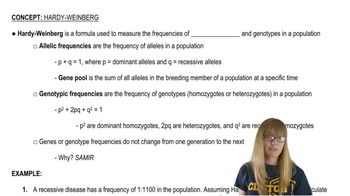
The Hardy-Weinberg principle provides a baseline to predict genotype frequencies in a large, randomly mating population without evolutionary forces. It relates allele frequencies (p and q) to genotype frequencies (p², 2pq, q²). Deviations from expected frequencies can indicate factors like inbreeding or selection.
Recommended video:
Guided course
Hardy Weinberg
Inbreeding Coefficient (F)
The inbreeding coefficient (F) measures the probability that two alleles at a locus are identical by descent. It quantifies the reduction in heterozygosity due to inbreeding compared to Hardy-Weinberg expectations. F ranges from 0 (no inbreeding) to 1 (complete inbreeding).
Recommended video:
Guided course
F Factor and Hfr
Genotype Frequencies and Phenotype Expression of Recessive Alleles
Recessive traits appear only in individuals homozygous for the recessive allele (cc). Heterozygous carriers (Cc) show the dominant phenotype but carry the recessive allele. Counting phenotypes and genotypes helps estimate allele frequencies and detect deviations caused by inbreeding.
Recommended video:
Guided course
Non-Random Mating
Related Videos
Related Practice
Textbook Question
396
views
