Go to the website http://www.cancer.gov and select 'Cancer Types' on the top menu bar. Scroll down to 'Breast Cancer' and click. Select 'Cases & Prevention' from the options. Click 'More information' and select 'BRCA Mutations: Cancer Risk and Genetic Testing'. Use the information on this page to answer the following questions. What features of family history increase the likelihood that a woman will have a harmful mutation of BRCA1 or BRCA2?
Table of contents
- 1. Introduction to Genetics51m
- 2. Mendel's Laws of Inheritance3h 37m
- 3. Extensions to Mendelian Inheritance2h 41m
- 4. Genetic Mapping and Linkage2h 28m
- 5. Genetics of Bacteria and Viruses1h 21m
- 6. Chromosomal Variation1h 48m
- 7. DNA and Chromosome Structure56m
- 8. DNA Replication1h 10m
- 9. Mitosis and Meiosis1h 34m
- 10. Transcription1h 0m
- 11. Translation58m
- 12. Gene Regulation in Prokaryotes1h 19m
- 13. Gene Regulation in Eukaryotes44m
- 14. Genetic Control of Development44m
- 15. Genomes and Genomics1h 50m
- 16. Transposable Elements47m
- 17. Mutation, Repair, and Recombination1h 6m
- 18. Molecular Genetic Tools19m
- 19. Cancer Genetics29m
- 20. Quantitative Genetics1h 26m
- 21. Population Genetics50m
- 22. Evolutionary Genetics29m
19. Cancer Genetics
Cancer Mutations
Problem 14
Textbook Question
Of the two classes of genes associated with cancer, tumor-suppressor genes and oncogenes, mutations in which group can be considered gain-of-function mutations? In which group are the loss-of-function mutations? Explain.
Verified step by step guidance1
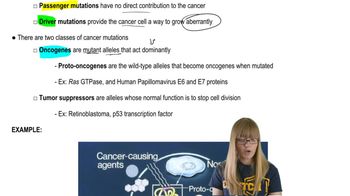
Understand the two classes of genes associated with cancer: tumor-suppressor genes and oncogenes. Tumor-suppressor genes normally act to inhibit cell division or promote apoptosis, preventing uncontrolled cell growth. Oncogenes, on the other hand, promote cell division and survival when activated.
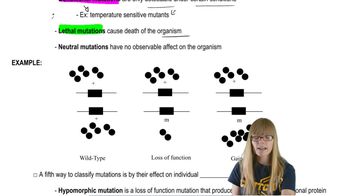
Recall the definitions of gain-of-function and loss-of-function mutations. Gain-of-function mutations result in a gene product with enhanced or new activity, while loss-of-function mutations reduce or eliminate the normal activity of the gene product.
Analyze oncogenes: mutations in oncogenes typically lead to gain-of-function, meaning the mutated gene is overactive or constitutively active, driving excessive cell proliferation. This is because oncogenes are like the 'gas pedal' for cell growth.
Analyze tumor-suppressor genes: mutations here are usually loss-of-function, meaning the gene loses its ability to regulate or inhibit cell growth. This loss removes the 'brakes' on cell division, allowing uncontrolled growth.
Summarize that gain-of-function mutations are characteristic of oncogenes, while loss-of-function mutations are characteristic of tumor-suppressor genes, explaining their roles in cancer development.
Verified video answer for a similar problem:This video solution was recommended by our tutors as helpful for the problem above
Video duration:
2mPlay a video:
Was this helpful?
Key Concepts
Here are the essential concepts you must grasp in order to answer the question correctly.
Oncogenes and Gain-of-Function Mutations
Oncogenes are mutated forms of proto-oncogenes that promote cell growth and division. Gain-of-function mutations in these genes lead to their overactivation or constant activity, driving uncontrolled cell proliferation and contributing to cancer development.
Recommended video:
Guided course
Functional Genomics
Tumor-Suppressor Genes and Loss-of-Function Mutations
Tumor-suppressor genes normally inhibit cell growth or promote apoptosis to prevent tumor formation. Loss-of-function mutations in these genes disable their protective roles, allowing cells to grow unchecked and increasing cancer risk.
Recommended video:
Guided course
Cancer Mutations
Difference Between Gain- and Loss-of-Function Mutations
Gain-of-function mutations enhance or create new gene activity, often dominant in oncogenes, while loss-of-function mutations reduce or eliminate gene activity, typically recessive in tumor-suppressor genes. Understanding this distinction is key to grasping how different gene classes contribute to cancer.
Recommended video:
Guided course
Mutations and Phenotypes
Related Videos
Related Practice
Textbook Question
419
views
