Determine whether the statements below are true or false. If a statement is false, provide the correct information or revise the statement to make it correct. If a dihybrid plant is self-fertilized, (1) 9/16 of the progeny will have the same phenotype as the F₁ parent. (2) 1/16 of the progeny will be true-breeding. (3) 1/2 of the progeny will be heterozygous at one or both loci.
Verified step by step guidance
1
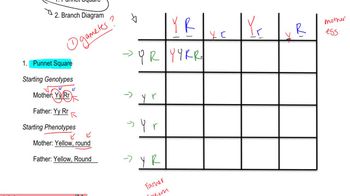
Step 1: Understand the context of the problem. A dihybrid plant refers to an organism heterozygous at two loci (e.g., AaBb). When such a plant is self-fertilized, the offspring will follow Mendel's dihybrid cross ratio of 9:3:3:1 for phenotypes, assuming independent assortment and no linkage between the loci.
Step 2: Analyze statement (1): '9/16 of the progeny will have the same phenotype as the F₁ parent.' The F₁ parent in a dihybrid cross typically exhibits the dominant phenotype for both traits. Using the 9:3:3:1 ratio, 9/16 of the progeny will indeed show the dominant phenotype for both traits. This statement is true.
Step 3: Analyze statement (2): '1/16 of the progeny will be true-breeding.' True-breeding individuals are homozygous at both loci (e.g., AABB or aabb). From the Punnett square of a dihybrid cross, there are four true-breeding genotypes: AABB, AAbb, aaBB, and aabb. Each occurs with a probability of 1/16. Therefore, the total proportion of true-breeding progeny is 4/16, not 1/16. This statement is false. The correct information is that 4/16 (or 1/4) of the progeny will be true-breeding.
Step 4: Analyze statement (3): '1/2 of the progeny will be heterozygous at one or both loci.' To verify this, calculate the probabilities of heterozygosity at one or both loci. Heterozygous at one locus includes genotypes AaBB, Aabb, aaBb, and AABb, each occurring with a probability of 2/16. Heterozygous at both loci (AaBb) occurs with a probability of 4/16. Adding these probabilities gives (2/16 + 2/16 + 2/16 + 2/16 + 4/16) = 12/16 = 3/4. This statement is false. The correct proportion is 3/4, not 1/2.
Step 5: Summarize the findings: Statement (1) is true. Statement (2) is false; the correct proportion of true-breeding progeny is 4/16 (or 1/4). Statement (3) is false; the correct proportion of progeny heterozygous at one or both loci is 3/4.
Verified video answer for a similar problem:
This video solution was recommended by our tutors as helpful for the problem above
Video duration:
5m
Play a video:
Was this helpful?
Key Concepts
Here are the essential concepts you must grasp in order to answer the question correctly.
Dihybrid Cross
A dihybrid cross involves two traits, each represented by two alleles. In Mendelian genetics, when two heterozygous individuals (e.g., AaBb x AaBb) are crossed, the phenotypic ratio of the offspring typically follows a 9:3:3:1 pattern. This means that 9 out of 16 offspring will display the dominant phenotype for both traits, which is crucial for understanding the expected outcomes in the given question.
True-breeding organisms are homozygous for a particular trait, meaning they consistently produce offspring with the same phenotype when self-fertilized. In the context of a dihybrid cross, true-breeding progeny can be identified as those that exhibit the same traits as their parents, which is essential for determining the proportion of true-breeding offspring in the progeny.
Heterozygosity refers to the presence of different alleles at a gene locus in an individual. In a dihybrid cross, the proportion of heterozygous offspring can be calculated based on the genotypic ratios. Understanding the distribution of heterozygous individuals is important for evaluating the genetic diversity and potential for variation in the progeny resulting from the self-fertilization of a dihybrid plant.