Table of contents
- 1. Introduction to Genetics51m
- 2. Mendel's Laws of Inheritance3h 37m
- 3. Extensions to Mendelian Inheritance2h 41m
- 4. Genetic Mapping and Linkage2h 28m
- 5. Genetics of Bacteria and Viruses1h 21m
- 6. Chromosomal Variation1h 48m
- 7. DNA and Chromosome Structure56m
- 8. DNA Replication1h 10m
- 9. Mitosis and Meiosis1h 34m
- 10. Transcription1h 0m
- 11. Translation58m
- 12. Gene Regulation in Prokaryotes1h 19m
- 13. Gene Regulation in Eukaryotes44m
- 14. Genetic Control of Development44m
- 15. Genomes and Genomics1h 50m
- 16. Transposable Elements47m
- 17. Mutation, Repair, and Recombination1h 6m
- 18. Molecular Genetic Tools19m
- 19. Cancer Genetics29m
- 20. Quantitative Genetics1h 26m
- 21. Population Genetics50m
- 22. Evolutionary Genetics29m
4. Genetic Mapping and Linkage
Multiple Cross Overs and Interference
Problem 14c
Textbook Question
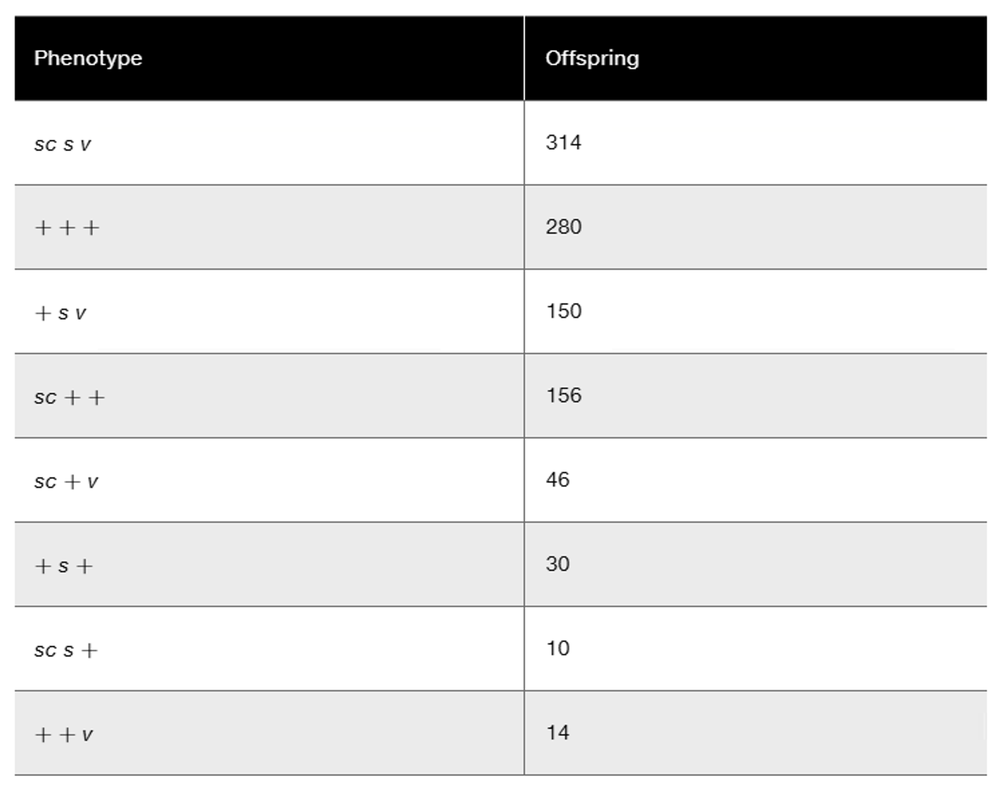
In Drosophila, a cross was made between females—all expressing the three X-linked recessive traits scute bristles (sc), sable body (s), and vermilion eyes (v)—and wild-type males. In the F1, all females were wild type, while all males expressed all three mutant traits. The cross was carried to the F2 generation, and 1000 offspring were counted, with the results shown in the following table.

No determination of sex was made in the data.
Are there more or fewer double crossovers than expected?
Verified step by step guidance1
Step 1: Identify the parental and recombinant phenotypes. The parental phenotypes are the most frequent classes, which are 'sc s v' (314 offspring) and '+++ ' (280 offspring). The recombinant phenotypes include single and double crossovers with lower numbers.
Step 2: Determine the gene order on the X chromosome. Use the single crossover classes to infer the order of the three genes (sc, s, v). Compare the phenotypes that differ by one gene to establish the linear order.
Step 3: Calculate the recombination frequencies between each pair of genes. Use the formula for recombination frequency: \(\text{RF} = \frac{\text{Number of recombinant offspring}}{\text{Total offspring}}\). Calculate RF for sc-s and s-v intervals using the appropriate single crossover classes.
Step 4: Calculate the expected frequency of double crossovers. Multiply the recombination frequencies of the two intervals: \(\text{Expected double crossover frequency} = \text{RF}_{sc-s} \times \text{RF}_{s-v}\). Then multiply by the total number of offspring (1000) to get the expected number of double crossovers.
Step 5: Compare the observed number of double crossovers (sum of the two double crossover classes: 'sc + v' and '+ s +') to the expected number calculated in Step 4. Determine if there are more or fewer double crossovers than expected, which can indicate interference.
Verified video answer for a similar problem:This video solution was recommended by our tutors as helpful for the problem above
Video duration:
1mPlay a video:
Was this helpful?
Key Concepts
Here are the essential concepts you must grasp in order to answer the question correctly.
X-linked Inheritance
X-linked inheritance refers to genes located on the X chromosome, which show distinct inheritance patterns, especially in species like Drosophila. Males (XY) express recessive X-linked traits if they inherit a mutant allele, while females (XX) must inherit two copies. This concept is crucial for understanding the phenotypic ratios in crosses involving X-linked traits.
Recommended video:
Guided course
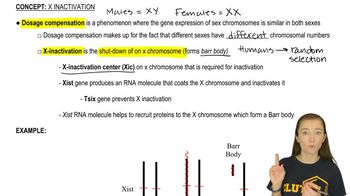
X-Inactivation
Genetic Recombination and Crossing Over
Genetic recombination occurs during meiosis when homologous chromosomes exchange segments, producing new allele combinations. Crossing over frequency between genes reflects their physical distance on a chromosome. Double crossovers involve two recombination events and are less frequent, affecting the observed offspring phenotypes.
Recommended video:
Guided course
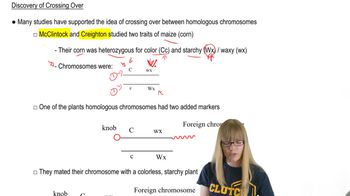
Discovery of Crossing Over
Double Crossover Frequency and Interference
Double crossover frequency is predicted by multiplying the probabilities of single crossovers between gene pairs. Interference occurs when one crossover reduces the likelihood of another nearby, leading to fewer double crossovers than expected. Analyzing observed versus expected double crossovers helps understand chromosome behavior during meiosis.
Recommended video:
Guided course
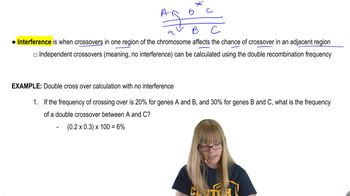
Multiple Cross Overs and Interference
Watch next
Master Multiple Cross Overs and Interference with a bite sized video explanation from Kylia
Start learningRelated Videos
Related Practice
Multiple Choice
The term 'multiple alleles' refers to the presence of how many or more alleles in the population?
36
views
