Self-InjuryAccording to the article “Self-injurious Behaviors in a College Population,” 17% of undergraduate or graduate students have had at least one incidence of self-injurious behavior. The researchers conducted a survey of 40 college students who reported a history of emotional abuse and found that 12 of them have had at least one incidence of self-injurious behavior. What do the results of this survey tell you about college students who report a history of emotional abuse?
Table of contents
- 1. Intro to Stats and Collecting Data1h 14m
- 2. Describing Data with Tables and Graphs1h 55m
- 3. Describing Data Numerically2h 5m
- 4. Probability2h 16m
- 5. Binomial Distribution & Discrete Random Variables3h 6m
- 6. Normal Distribution and Continuous Random Variables2h 11m
- 7. Sampling Distributions & Confidence Intervals: Mean3h 23m
- Sampling Distribution of the Sample Mean and Central Limit Theorem19m
- Distribution of Sample Mean - Excel23m
- Introduction to Confidence Intervals15m
- Confidence Intervals for Population Mean1h 18m
- Determining the Minimum Sample Size Required12m
- Finding Probabilities and T Critical Values - Excel28m
- Confidence Intervals for Population Means - Excel25m
- 8. Sampling Distributions & Confidence Intervals: Proportion1h 25m
- 9. Hypothesis Testing for One Sample3h 29m
- 10. Hypothesis Testing for Two Samples4h 50m
- Two Proportions1h 13m
- Two Proportions Hypothesis Test - Excel28m
- Two Means - Unknown, Unequal Variance1h 3m
- Two Means - Unknown Variances Hypothesis Test - Excel12m
- Two Means - Unknown, Equal Variance15m
- Two Means - Unknown, Equal Variances Hypothesis Test - Excel9m
- Two Means - Known Variance12m
- Two Means - Sigma Known Hypothesis Test - Excel21m
- Two Means - Matched Pairs (Dependent Samples)42m
- Matched Pairs Hypothesis Test - Excel12m
- 11. Correlation1h 24m
- 12. Regression1h 50m
- 13. Chi-Square Tests & Goodness of Fit2h 21m
- 14. ANOVA1h 57m
9. Hypothesis Testing for One Sample
Performing Hypothesis Tests: Proportions
Problem 10.R.10
Textbook Question
Emergency Room The proportion of patients who visit the emergency room (ER) and die within the year is 0.05. Source: SuperFreakonomics. Suppose a hospital administrator is concerned that his ER has a higher proportion of patients who die within the year. In a random sample of 250 patients who have visited the ER in the past year, 17 have died. Should the administrator be concerned?
Verified step by step guidance1
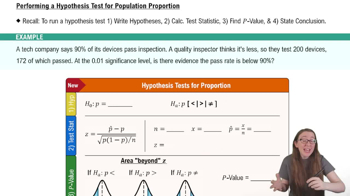
Identify the null hypothesis \( H_0 \) and the alternative hypothesis \( H_a \). Here, \( H_0: p = 0.05 \) (the proportion of patients who die is 0.05) and \( H_a: p > 0.05 \) (the proportion is higher than 0.05).
Calculate the sample proportion \( \hat{p} \) using the data: \( \hat{p} = \frac{17}{250} \).
Compute the standard error (SE) of the sampling distribution under the null hypothesis using the formula:
\( SE = \sqrt{\frac{p(1-p)}{n}} \)
where \( p = 0.05 \) and \( n = 250 \).
Calculate the test statistic (z-score) using the formula:
\( z = \frac{\hat{p} - p}{SE} \)
This measures how many standard errors the sample proportion is away from the hypothesized proportion.
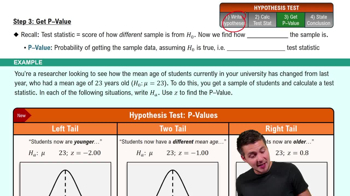
Determine the p-value corresponding to the calculated z-score for a right-tailed test. Compare the p-value to a significance level (commonly \( \alpha = 0.05 \)) to decide whether to reject \( H_0 \) and conclude if the administrator should be concerned.
Verified video answer for a similar problem:This video solution was recommended by our tutors as helpful for the problem above
Video duration:
4mPlay a video:
Was this helpful?
Key Concepts
Here are the essential concepts you must grasp in order to answer the question correctly.
Hypothesis Testing for Proportions
Hypothesis testing for proportions involves assessing whether the observed sample proportion significantly differs from a known or claimed population proportion. It uses a null hypothesis (e.g., the ER death rate is 0.05) and an alternative hypothesis (e.g., the ER death rate is higher) to determine if the sample data provides enough evidence to reject the null.
Recommended video:
Performing Hypothesis Tests: Proportions
Sampling Distribution of a Proportion
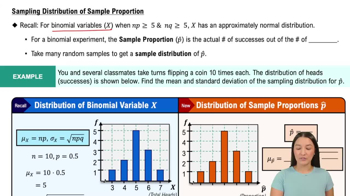
The sampling distribution of a sample proportion describes how the proportion varies from sample to sample. For large samples, it approximates a normal distribution with mean equal to the population proportion and standard error calculated from the population proportion and sample size, enabling probability calculations.
Recommended video:
Sampling Distribution of Sample Proportion
Significance Level and p-value
The significance level (commonly 0.05) is the threshold for deciding whether to reject the null hypothesis. The p-value measures the probability of observing a sample proportion as extreme as the one obtained, assuming the null is true. A p-value less than the significance level indicates strong evidence against the null.
Recommended video:
Guided course
Step 3: Get P-Value
Watch next
Master Performing Hypothesis Tests: Proportions with a bite sized video explanation from Patrick
Start learningRelated Videos
Related Practice
Textbook Question
14
views